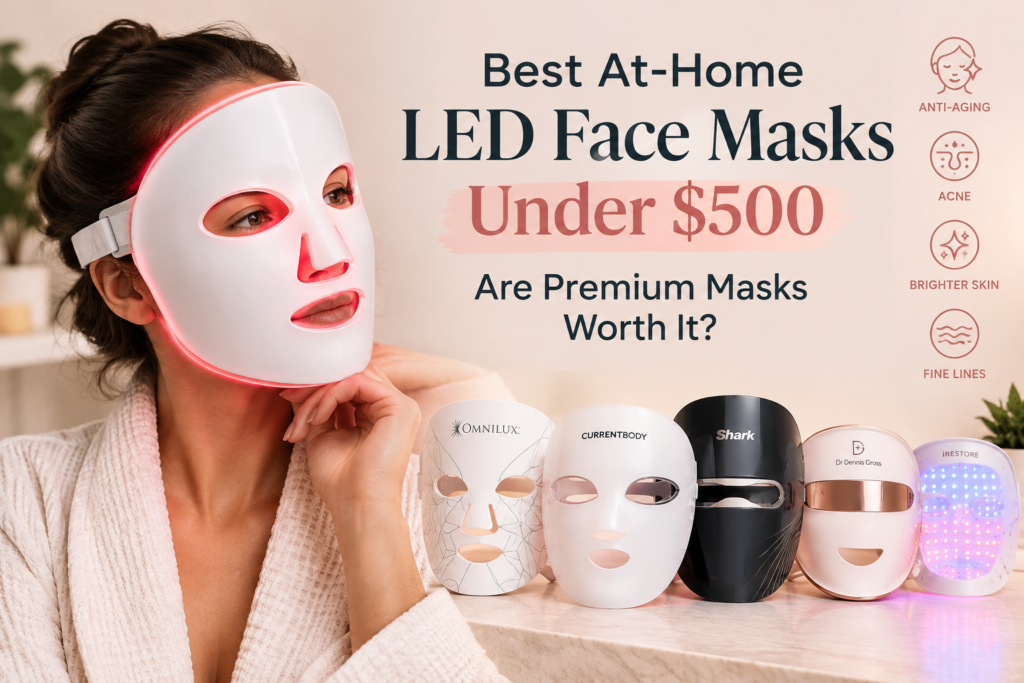
LED face masks now range from budget dupes under $100 to premium devices that creep close to $500. That gap naturally raises a question: are the expensive ones actually better, or are you mostly paying for a name?
Affiliate disclosure: Petal Beauty Skincare is a participant in the Amazon Associates program. If you buy through links on this page, we may earn a small commission at no extra cost to you. These are third-party products available through Amazon and other retailers.
The honest answer depends on wavelengths, irradiance (how strong the light really is), coverage, comfort, treatment time, FDA clearance — and one factor that matters more than any spec sheet: whether you’ll actually use the mask consistently. A $450 mask sitting in a drawer does nothing. A $200 mask worn several nights a week for a year can outperform it.
This guide compares five well-known LED masks under $500 and breaks down what you’re really paying for at each price point, so you can decide whether spending closer to $500 makes sense — or whether a more modest option covers what you need.
Quick Comparison
| LED Face Mask | Approx. Price | Best For | Key Wavelengths | Treatment Time | Premium Value |
|---|---|---|---|---|---|
| CurrentBody Skin Series 2 | ~$470 | Widest wavelength range | Red 633nm, NIR 830nm, deep NIR 1072nm | 10 min | High, if deep-NIR matters to you |
| Omnilux Contour Face | ~$395 | Evidence-backed anti-aging | Red 633nm, NIR 830nm | 3–5x/week protocol | High, strongest research base |
| Dr. Dennis Gross SpectraLite FaceWare Pro | ~$455 | Acne + anti-aging combo | Red + blue light | 3 min | Moderate, convenience-driven |
| iRESTORE Illumina | ~$399 (list $499) | Multiple concerns at once | Red 635nm, NIR 830nm, blue 415nm | 10 min | Good, most LEDs for the price |
| Shark CryoGlow | ~$350 | Anti-aging plus depuffing | Red, blue, deep infrared | 4–8 min by mode | Good, lowest price with cooling extra |
Check Price on Amazon via the product links above — prices and specs change often, so confirm details on the retailer’s page before buying.
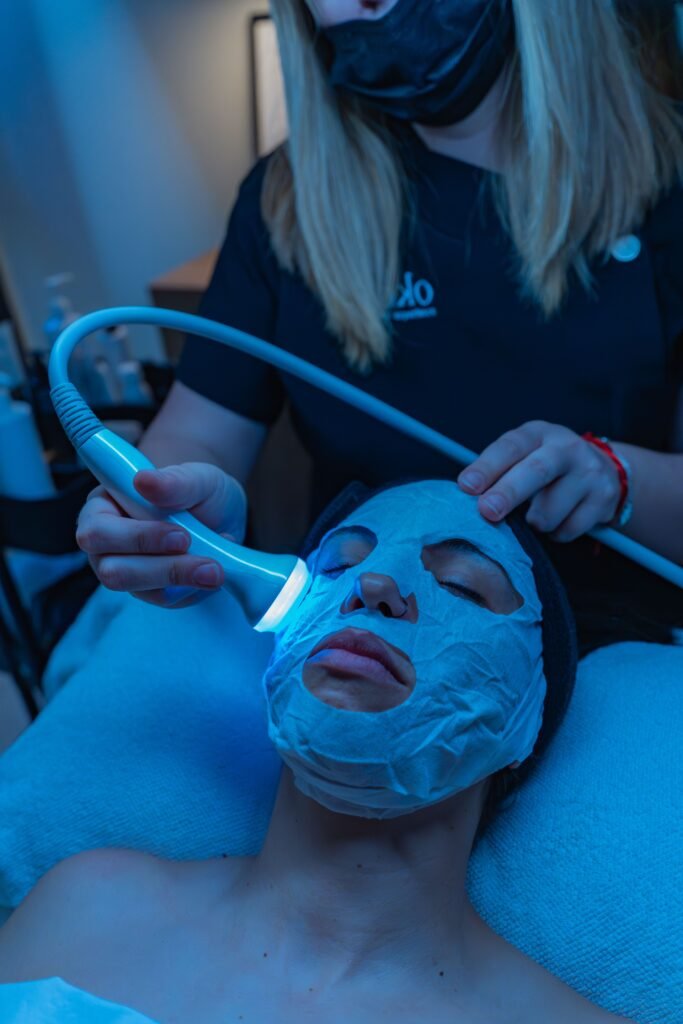
What Makes an LED Mask “Premium”?
Price alone doesn’t determine effectiveness. The specs that actually separate a well-designed mask from an overpriced one:
- Wavelengths — red (~630–660nm) is linked to collagen/fine-line support; near-infrared (~800–850nm) reaches deeper; blue (~415nm) targets acne bacteria.
- Irradiance — how strong the light is at your skin (mW/cm²); higher isn’t automatically better, but it needs to be strong enough to matter.
- LED placement and coverage — more LEDs spread evenly means fewer gaps.
- Distance between LEDs and skin — a flush fit delivers more consistent light than a gapping one.
- Treatment time, fit, comfort, and build quality.
- Warranty and FDA clearance — look for “FDA-cleared” or “510(k)-cleared,” not “FDA-approved.” Clearance means the FDA found a device safe and substantially equivalent to an existing one; it doesn’t certify effectiveness, according to UCLA Health’s guidance on red light therapy.
- Clinical evidence on the specific device, not just LED therapy in general.
- Ease of consistent use — the best mask on paper is worthless if you stop wearing it.
Best At-Home LED Face Masks Under $500
1. CurrentBody Skin Series 2 — Best for Deep Anti-Aging

- Enhanced collagen production capability significantly reduces fine lines, wrinkles and redness, for younger-looking skin…
- Upgraded light coverage provides our famous instant glow, for a healthier, brighter and smoother complexion.
- An all-new, exclusive layout of 236 LED bulbs emits three clinically recognised wavelengths: red (633nm), near-infrared …
Price: ~$470 · Wavelengths: Red 633nm, NIR 830nm, deep NIR 1072nm · Time: 10 minutes, 3–5x/week
Series 2 is the only mask here adding a third wavelength — 1072nm deep near-infrared — to the standard red/NIR pairing, delivered through 236 LEDs in a flexible silicone design with extended jaw and chin coverage. It’s FDA-cleared.
Pros: Widest wavelength range; flexible, cordless; strong coverage. Cons: Priciest option here; the extra wavelength has less independent consumer research than standard red/NIR. Buy it if: you want the broadest wavelength coverage and don’t mind the top price. Skip it if: you mainly need one basic function or aren’t sure you’ll use a mask daily. Worth the price? The extra wavelength is real, but whether it’s worth roughly $75 more than Omnilux depends on how much you value it specifically.
2. Omnilux Contour Face — Best for Evidence-Backed Anti-Aging
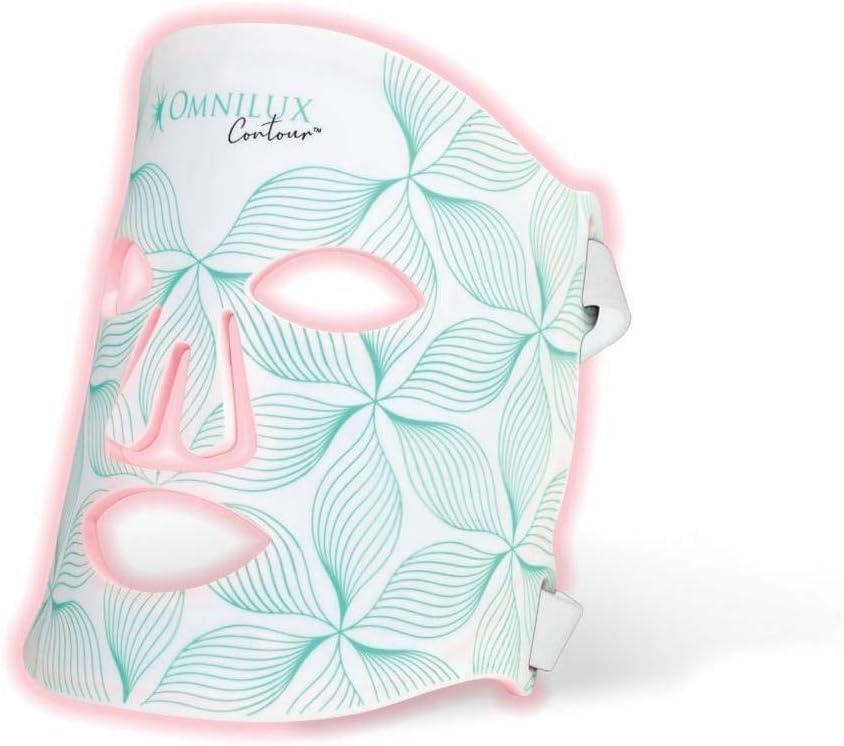
Price: ~$395 · Wavelengths: Red 633nm, NIR 830nm · Time: 3–5 sessions/week for 4–6 weeks
Omnilux’s technology has been cited in dozens of independent, peer-reviewed studies over roughly two decades — more than most competitors here. The Contour Face is a semi-rigid, FDA-cleared device (510(k) K191629) that holds LEDs at a fixed distance from skin rather than using flexible silicone.
Pros: Strongest research history of the group; FDA-cleared; simple, no-app design. Cons: No blue light for acne; semi-rigid shell fits some faces better than others. Buy it if: research depth matters most to you. Skip it if: you also want acne-specific light. Worth the price? Likely yes — of the five, this has the clearest evidence trail behind its exact wavelength combination.
3. Dr. Dennis Gross SpectraLite FaceWare Pro — Best for Acne + Anti-Aging
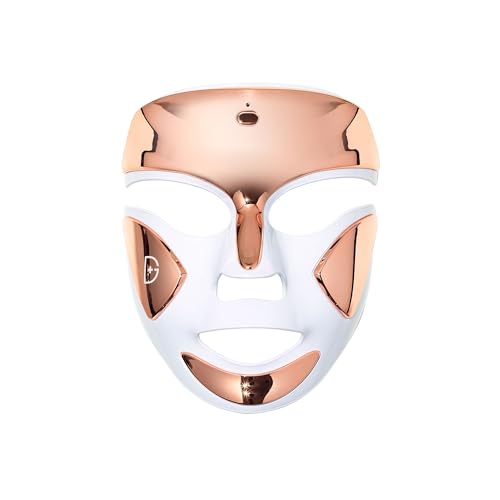
- WHAT IT IS: This LED device for the face targets wrinkles and acne for visibly smoother, clearer skin in just 3 minutes….
- HOW IT WORKS: Treat acne and breakouts with blue light, smooth wrinkles and build collagen with red light, or address bo…
- HOW TO USE: After cleansing, place the mask over your face, securing the strap around your head. Press & hold the power …
Price: ~$455 · Wavelengths: Red and blue light (~100 red LEDs, ~60 blue LEDs) · Time: 3 minutes
The fastest treatment on this list, which makes daily use easier. The hard-shell, FDA-cleared design combines red light for fine lines with blue light for acne-causing bacteria.
Pros: Very short sessions support consistency; dual red/blue function; well-known dermatologist branding. Cons: No near-infrared wavelength; rigid shell doesn’t contour every face; shorter session likely means a lower total light dose than 10-minute masks. Buy it if: you want one device for both breakouts and early aging signs. Skip it if: maximum anti-aging power is the priority. Worth the price? Partly — you’re paying largely for convenience and dual functionality, not a stronger dose.
4. iRESTORE Illumina — Best for Multiple Skin Concerns
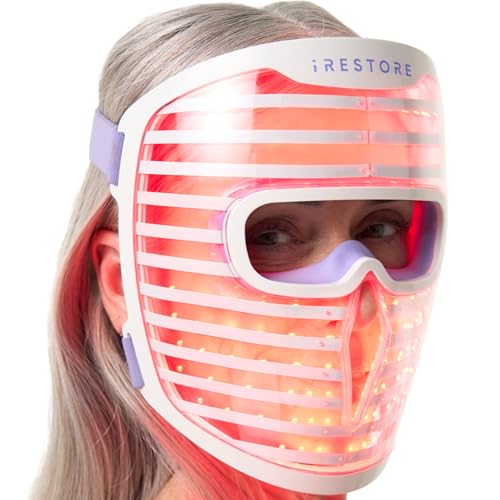
- The Most Powerful Red Light Mask for Visible Results: Experience professional-level rejuvenation at home with 360 LEDs, …
- Advanced Triple-Wavelength Technology: Powered by 3 scientifically backed wavelengths – Red (635nm), Infrared (830nm), a…
- Designed for Comfort and Multitasking: Lightweight yet sturdy, our dual-strap face mask hovers comfortably over your fac…
Price: ~$399 (list ~$499) · Wavelengths: Red 635nm, NIR 830nm, blue 415nm · Time: 10 minutes, 3–5x/week
With roughly 360 total LED chips running all three wavelengths simultaneously, Illumina has one of the highest LED counts here, plus a generous 100-day return window and built-in eye shields.
Pros: High LED count; three simultaneous wavelengths; long return window; comfortable hybrid design. Cons: Independent testing measures its irradiance as moderate rather than top-tier, so more LEDs doesn’t mean the strongest light per LED. Buy it if: you’re juggling more than one concern (aging, dullness, occasional breakouts). Skip it if: you want the single strongest wavelength-specific dose. Worth the price? Yes, for a “one mask, three concerns” use case — it’s priced competitively against Dr. Dennis Gross while covering more ground.
5. Shark CryoGlow — Best for Convenience Extras
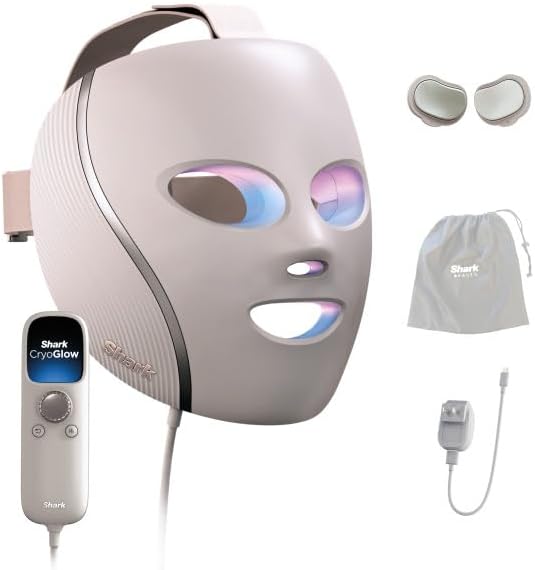
- RED LIGHT THERAPY MASK: CryoGlow is an at-home LED face mask combining red, blue & deep infrared light with under-eye co…
- MOST AWARDED LED MASK IN THE U.S.*: Real people. Real results. Clinically tested on 119 participants by an independent t…
- EXPERTLY DEVELOPED: Developed by Shark Beauty alongside optical light experts and engineers, bringing MedSpa-inspired re…
Price: ~$350 · Wavelengths: Red, blue, deep infrared, plus a separate cooling mode · Time: 4–8 minutes by mode
Shark’s first skincare device is also the least expensive on this list, adding something none of the others offer: built-in under-eye cooling pads for quick depuffing. It’s FDA-cleared with four preset modes.
Pros: Lowest price of the group; genuinely useful cooling feature; multiple short, targeted modes. Cons: Newer to market than CurrentBody or Omnilux, so less long-term track record; heavier hard-shell design. Buy it if: you want LED therapy plus puffiness relief without spending $400+. Skip it if: maximum light dose is your only priority. Worth the price? This is the value pick — FDA clearance and three wavelengths for less than any other mask here, plus a real cooling bonus.
Does a $450 Mask Work Better Than a $200 Mask?
Not necessarily. Price alone tells you almost nothing about effectiveness. What matters is whether a device delivers the right wavelengths at sufficient irradiance, for long enough, over enough of your face — consistently, over months. A $450 mask used sporadically will likely underperform a $200 mask worn several nights a week.
Before assuming higher price means better results, compare: wavelength accuracy (roughly 630–660nm red, 800–850nm NIR), irradiance, dose (irradiance × time), coverage, fit, and consistency — the mask you’ll actually use beats the one with the best spec sheet sitting in a drawer. A less expensive, well-specified mask can be the better value if you’ll use it reliably; a premium mask only earns its price if its extra features translate into something you genuinely benefit from.
What You’re Really Paying For With Premium Masks
Extra dollars in the $400–$500 range typically go toward: brand reputation, clinical research, better materials and design, comfort, warranty and support, more sophisticated LED configuration, the regulatory testing behind FDA clearance, convenience features (cordless operation, auto shut-off), and marketing. None of this is a scam — but it means price doesn’t scale proportionally with results. A $450 mask isn’t twice as effective as a $225 one just because it costs twice as much.
Cost Per Use: Is It Worth It?
A $400 mask used four times a week for a year (about 208 sessions) works out to roughly $1.92 per session in year one — dropping to about $0.64 if it lasts three years. A $200 mask used the same way costs about $0.96 per session in year one, or $0.32 over three years. The premium mask costs more per use, but the gap shrinks the longer you actually use it. If you’re confident you’ll stick with the routine for years, the upfront gap matters less. If you’re not sure, a lower entry cost limits your downside.
Who Should Spend $400–$500?
- Wants a proven, well-established brand
- Prioritizes comfort and a flexible fit
- Wants multiple wavelengths in one device
- Values a strong warranty and support
- Plans to use it consistently for years, not months
- Has budget room to spare
Who Should Skip It?
- First-time LED users unsure they’ll like the routine
- Anyone with a track record of abandoning skincare devices
- Shoppers who only need one basic function
- Anyone who can meet their goal with a lower-cost, FDA-cleared option
- Anyone expecting fast, dramatic results — LED therapy is gradual regardless of price
How to Choose the Right Mask
- Wavelength matched to your goal (red/NIR for aging, blue for acne)
- Documented irradiance
- A treatment time you’ll realistically commit to
- Full-face coverage
- Fit — flexible silicone vs. rigid shell
- Comfort
- FDA clearance where applicable
- Warranty length
- Return policy
- Fit for your specific goal
Are LED Face Masks Worth It in 2026?
For most people, yes — as a convenient, generally safe addition to a skincare routine, not a replacement for dermatologist-level treatment. Results are gradual, and consistency matters more than the exact model. Pair sessions with supportive basics: a barrier-friendly moisturizer like the picks in our CeraVe vs. Vanicream comparison, daily sunscreen (see our Beauty of Joseon vs. Round Lab breakdown), and, if you’re also targeting acne marks or uneven tone, an active like the ones compared in niacinamide vs. vitamin C for acne marks. Reactive skin post-treatment can also benefit from a calming ingredient — our Centella Asiatica vs. Aloe Vera guide compares which soothes redness better. If you’re weighing premium vs. budget skincare tools generally, our affordable Amazon alternatives to Drunk Elephant guide tackles the same question for products.
Final Verdict
- Best Overall Premium Value: Omnilux Contour Face — strongest research relative to price
- Best for Wrinkles/Anti-Aging: CurrentBody Series 2 — widest wavelength range
- Best for Acne + Anti-Aging: Dr. Dennis Gross SpectraLite FaceWare Pro
- Best Multi-Concern Option: iRESTORE Illumina — three wavelengths at once
- Best Premium Alternative on a Lower Budget: Shark CryoGlow
- Best for Maximum Convenience: Dr. Dennis Gross, for its 3-minute sessions
So, are premium LED masks worth it? They can be, if comfort, design, evidence, warranty, and — most importantly — consistent long-term use matter to you. But don’t assume a $450 mask is automatically twice as effective as a $200 one. Compare actual wavelengths, irradiance, and coverage against your own likelihood of sticking with the routine before deciding how much to spend.
FAQ
Are LED face masks under $500 worth it? For most people, yes, if the device has appropriate wavelengths, adequate irradiance, and FDA clearance — and you’ll actually use it consistently.
Is a $400 LED face mask worth it? It can be, especially with features that keep you consistent, like comfort or multiple wavelengths. It isn’t automatically twice as effective as a $200 mask.
What is the best LED face mask under $500? It depends on your goal: Omnilux for research-backed anti-aging, CurrentBody for the widest wavelength range, Dr. Dennis Gross for combined acne/aging, iRESTORE for multiple concerns, Shark CryoGlow for the lowest price with added cooling.
Is CurrentBody better than Omnilux? CurrentBody adds a deep-NIR wavelength and costs more; Omnilux has a longer independent research history behind its two wavelengths. Neither is objectively better — it depends what you value more.
What’s the difference between red light and near-infrared light? Red light (~630–660nm) works closer to the surface and is linked to collagen support and fine-line improvement. Near-infrared (~800–850nm) penetrates deeper and is often paired with red light for broader support.
How often should you use an LED face mask? Most brands recommend 3–5 sessions weekly, though it varies by device — always follow the manufacturer’s specific instructions.
Are expensive LED masks better than cheap ones? Not automatically. Correct wavelengths, adequate irradiance, and real coverage matter more than price. A well-specified budget mask used consistently can outperform an expensive one used rarely.
Can LED masks help with wrinkles and fine lines? Some research suggests red and near-infrared light can produce subtle-to-noticeable improvements in fine lines and texture with consistent use, though results are gradual and vary by individual — these devices are a complementary tool, not a guaranteed fix.
This article discusses general LED/red-light therapy research alongside specific consumer devices; evidence on light therapy broadly doesn’t automatically apply to every individual product, and results vary. Confirm current pricing, specs, and clearance status on official manufacturer or retailer pages before buying, and consult a dermatologist about specific skin concerns — see the American Academy of Dermatology’s guidance on red light therapy.