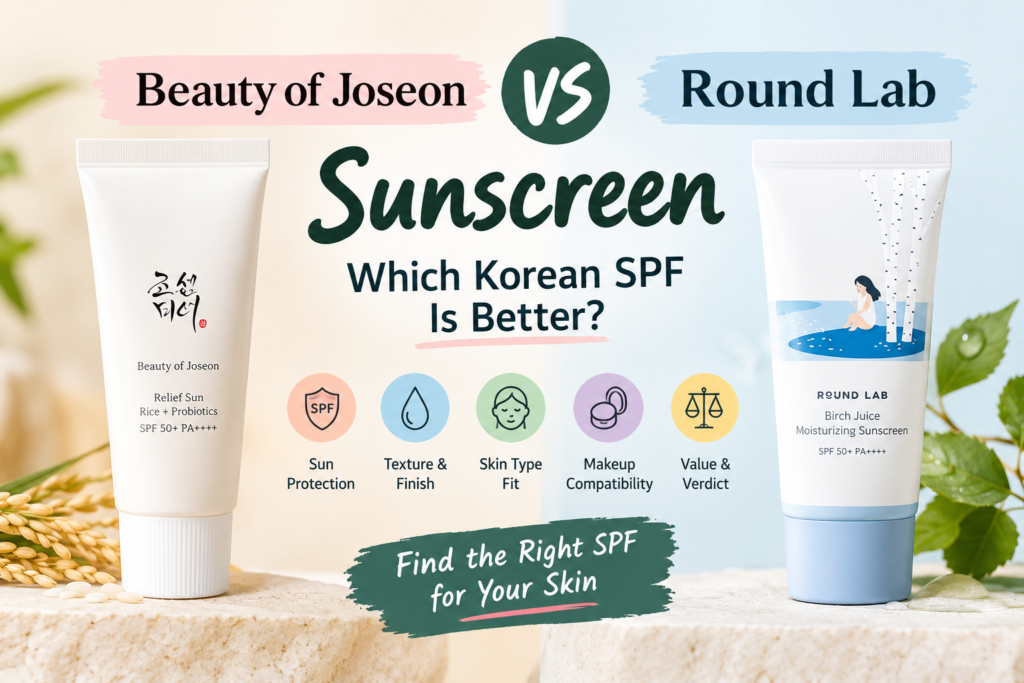
Beauty of Joseon vs Round Lab sunscreen is one of the most common Korean SPF debates, and it’s easy to see why. Both come in 50 mL tubes, both use chemical (organic) filters, both carry SPF 50+ PA++++ on Korean packaging, and both cost about the same. What separates them is harder to read off a label: how the formula feels, how it finishes, whether you wear makeup over it, and which version you’re actually buying.
As an Amazon Associate, Petal Beauty Skincare earns from qualifying purchases. This means we may earn a commission at no extra cost to you.
We haven’t tested either product ourselves. This guide draws on brand information, Consumer Reports’ lab testing, and independent reviewer observations, and it tells you which is which.
Quick Verdict
There’s no universal winner. Choose Beauty of Joseon Relief Sun if you want a rice-and-ferment base that the brand describes as fragrance-free and alcohol-free. Choose Round Lab Birch Juice if you want a hydration-focused formula built around birch sap and hyaluronic acid, and you’re comfortable with a few botanical oils in the ingredient list.
Independent reviewers disagree on how dewy or matte each one looks, so finish alone shouldn’t decide it. Check the exact version, since Korean and US formulas can differ.

- [NBC SELECT’S #1 FACIAL SUNSCREEN]: Ranked No.1 out of 100+ sunscreens tested by NBC Select editors. Praised for its hyd…
- [OTC REGISTERED, TRUSTED SUN PROTECTION]: This OTC registered UV Lock sunscreen is developed to retain the soothing, moi…
- [LIGHTWEIGHT TEXTURE WITH NO WHITE CAST]: The non-greasy, lightweight essence texture applies seamlessly, leaving no whi…
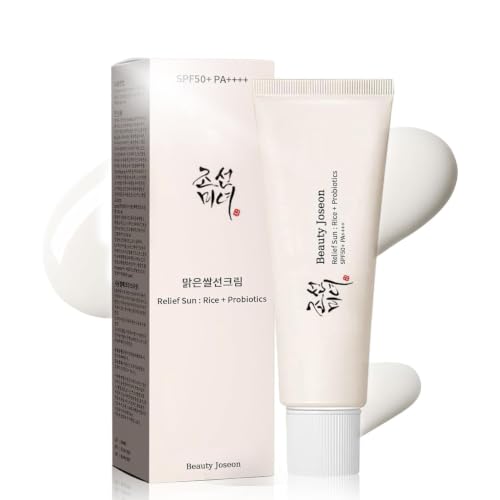
- 1.Korean Rice Probiotics Anti-black frost offers , ideal for all skin types.
- 2.Enriched with nourishing ingredients for superior skin protection and deep hydration.
- 3.Provides long-lasting moisture to keep skin supple and hydrated.
Beauty of Joseon vs Round Lab at a Glance
| Feature | Beauty of Joseon Relief Sun | Round Lab Birch Juice Moisturizing Sunscreen |
|---|---|---|
| Labeled SPF/PA by market | Korean-market: SPF 50+ PA++++. The brand’s separate US sunscreen, Day Dew, is a different product | Korean-market: SPF 50+ PA++++. The US “UVLock” version is titled SPF 50 on the brand’s US page, though some images say SPF 45 |
| Size | 50 mL (confirm on your listing) | 50 mL (confirm on your listing) |
| Main featured ingredients | Rice extract, fermented rice/grain extracts; niacinamide on versions labeled “Rice + Niacinamide” | Birch sap, hyaluronic acid, niacinamide, allantoin |
| UV-filter type | Organic (chemical) filters | Organic (chemical) filters in Korean versions; the US version lists avobenzone, homosalate and octisalate |
| Texture | Brand says creamy, lightweight, non-sticky | Brand says lightweight, soft cream |
| Finish | Reviewers report satin to dewy | Brand says dewy; one dermatologist reviewer found it matte |
| Moisturizing feel | Moisturizer-like, per brand and reviewers | Hydration-focused, though one reviewer found it not very moisturizing |
| Potential skin-type fit | Normal, dry, combination; oily skin may find it shiny | Normal, dry, combination; oily skin may find it shiny |
| Makeup compatibility | Brand says it layers well; thin layers recommended | Marketed for layering; let it set first |
| Water resistance | No claim on the official pages we reviewed | No claim on the official page we reviewed |
Beauty of Joseon vs Round Lab: What’s the Difference?
In plain English, the Korean versions of these sunscreens are closer than their fan bases suggest. Dr. Rachel Ho, an aesthetic doctor, notes in her Round Lab review that both are made by the same Korean manufacturer, Kolmar Korea, and use the same UV filters. A UK retailer’s Beauty of Joseon listing also names Kolmar Korea as the maker.
Three practical differences remain:
- The skincare base. Beauty of Joseon leans on rice and fermented extracts. Round Lab leans on birch sap and humectants like hyaluronic acid.
- Botanical extras. Round Lab’s ingredient lists include chamomile flower oil, which Dr. Ho flags as a possible allergen. Beauty of Joseon describes its formula as fragrance-free and alcohol-free, per the brand information summarized in our Beauty of Joseon Relief Sun review.
- Version confusion. Both brands sell different formulas in different markets, which matters more than any texture difference.
Ingredients Compared
Beauty of Joseon Relief Sun
The name has changed over time. Some packaging says “Rice + Probiotics,” while newer listings say “Rice + Niacinamide.” We couldn’t confirm with the brand whether the formula changed, so compare the ingredient list on your box.
The retailer listing we checked names four organic filters: ethylhexyl triazone, diethylamino hydroxybenzoyl hexyl benzoate, diethylhexyl butamido triazone, and methylene bis-benzotriazolyl tetramethylbutylphenol. It also cites 30% rice extract and rice ferment filtrates. “Probiotics” refers to those ferments, not live bacteria. Treat the 30% figure as a brand claim.
Rice extract and ferments are generally used for conditioning and comfort, and niacinamide is a common skin-conditioning ingredient. None of this means the sunscreen treats acne, dark spots or aging. Its main job is UV protection.
Check Price on Amazon: Beauty of Joseon Relief Sun
- 1.Korean Rice Probiotics Anti-black frost offers , ideal for all skin types.
- 2.Enriched with nourishing ingredients for superior skin protection and deep hydration.
- 3.Provides long-lasting moisture to keep skin supple and hydrated.
Round Lab Birch Juice Moisturizing Sunscreen
Dr. Ho lists four filters for the Korean version: Uvinul A Plus, Uvinul T 150, Tinosorb M and Iscotrizinol. Its hydrating side comes from birch sap, hyaluronic acid, niacinamide and allantoin. Humectants like hyaluronic acid draw water to the skin’s surface, and allantoin is a soothing, softening ingredient.
Dr. Ho also notes that dermatology data on birch sap is very limited, so treat it as a pleasant base ingredient rather than a proven skin treatment. As our Round Lab Birch Juice sunscreen review explains, the US ingredient list also includes chamomile flower oil and pine leaf oil, which can bother people with fragrance or botanical sensitivities.
Check Price on Amazon: Round Lab Birch Juice
- [NBC SELECT’S #1 FACIAL SUNSCREEN]: Ranked No.1 out of 100+ sunscreens tested by NBC Select editors. Praised for its hyd…
- [OTC REGISTERED, TRUSTED SUN PROTECTION]: This OTC registered UV Lock sunscreen is developed to retain the soothing, moi…
- [LIGHTWEIGHT TEXTURE WITH NO WHITE CAST]: The non-greasy, lightweight essence texture applies seamlessly, leaving no whi…
Texture, Finish, and White Cast
What the brands say. Both describe lightweight, comfortable formulas with no white cast.
What independent testers observed. Consumer Reports ran a small comparison of Korean and US formulas from both brands. Its sensory panel was blind to brand and found all six sunscreens took effort to rub in, felt greasy at first and left a white cast initially. After about 10 minutes they absorbed fairly well, with a slight greasy feel left over, and they left skin feeling moisturized with a dewy look. The panel did not find any of them “barely there.”
That conflicts with the brands’ no-white-cast claims, and with Dr. Ho’s own experience, which was also mixed. In her review, Round Lab left no white cast on her but Beauty of Joseon did. She noted that Tinosorb M, a particle-based filter shared by both Korean formulas, can cause a cast on some people. These are individual observations, not guarantees.
Our take. Expect a possible faint cast, especially on deeper skin tones or if you apply a generous layer. Test on your jawline in daylight.
Which Sunscreen Is Better for Your Skin Type?
| Skin type | Beauty of Joseon | Round Lab | Notes |
|---|---|---|---|
| Oily | May look shiny; the brand points oily-skin shoppers to its lighter Aqua-Fresh formula | May look shiny, though one reviewer found it light | Neither is a confirmed matte formula |
| Dry | Likely comfortable; layer moisturizer underneath if needed | Likely comfortable, with a hydration-focused base | Reviewer opinions on hydration conflict |
| Combination | Usually workable | Usually workable | Use a thinner layer on the T-zone |
| Normal | Easiest match for either | Easiest match for either | Choose by finish and ingredient preference |
| Sensitive | Fragrance-free and alcohol-free per the brand | Contains botanical oils; check the full list | “Sensitive skin” isn’t an FDA-defined label |
| Acne-prone | Can’t be promised breakout-safe | Can’t be promised breakout-safe | We couldn’t verify non-comedogenic claims for either |
| Dehydrated | Possible fit | Possible fit, given the humectants | Pair with a moisturizer |
Individual tolerance varies. Sensitive skin doesn’t automatically tolerate either formula, so patch-test behind the ear or on the jawline first. The American Academy of Dermatology notes that dermatologists often recommend mineral sunscreens (zinc oxide or titanium dioxide) for sensitive skin, and both of these are chemical-filter formulas.
Which Is Better Under Makeup?
Both brands say their sunscreens layer well, but pilling usually depends on how much you apply and what’s underneath. Consumer Reports’ panel found these formulas needed effort to rub in, so the usual advice applies: use thin layers, let each product settle for a few minutes, and apply foundation last. If a sunscreen pills, reduce the products underneath rather than the amount of sunscreen. We can’t guarantee either one works with every foundation or primer.
Which Is Better for Hot Weather and Outdoor Use?
Comfortable daily wear is not the same as verified water resistance. Neither the Beauty of Joseon pages nor the Round Lab US page we reviewed claim water resistance, so don’t assume either holds up for swimming, sports or heavy sweating.
The FDA says no sunscreen is truly waterproof, and that “water resistant” products must be tested and state 40 or 80 minutes of protection. It recommends applying about 15 minutes before sun exposure and reapplying at least every two hours, more often if you’re sweating or swimming. The American Academy of Dermatology adds that you should reapply after toweling off. For beach days or workouts, pick a sunscreen whose label states water resistance.
In heat and humidity, dewier finishes can look shinier. That’s a comfort issue, not a protection issue.
Price, Value, and Amazon Buying Tips
Both tubes are 50 mL, so price per milliliter is the price divided by 50. A $20 tube works out to $0.40 per mL, for example. We can’t verify live Amazon prices, so check both listings and compare. The Round Lab US price on its official page was $24.99 when we last reviewed it, or about $0.50 per mL.
Korean vs. US versions matter. Consumer Reports found the Korean formulas it tested provided better protection than the US formulas from the same brands. It also noted Korean formulas that use filters not approved by the FDA can’t be legally sold in the US, and that overseas purchases risk border seizure. The US-market products it tested, including a Round Lab UVLock product and Beauty of Joseon’s Day Dew, are not the same as the products compared here, so don’t assume those results transfer. They do show that two tubes with similar branding can perform differently.
Don’t treat labels as guarantees. Consumer Reports’ small test (three panelists for SPF) measured average SPF 36 for Beauty of Joseon’s Korean formula and 46 for Round Lab’s, against SPF 50+ labels, with top UVA scores for both. It stressed this was not a definitive answer. Both results exceed the SPF 30 the AAD recommends, but they show label numbers and measured numbers can differ.
Before you order on Amazon, check:
- The exact product name and SPF/PA wording (SPF 50+ PA++++ vs. SPF 45 or 50)
- Whether it’s the Korean or US formula
- The ingredient list, especially if you have allergies
- The seller and who ships it. Not every listing is authentic or authorized, and we can’t vouch for any specific seller
- The current price, size and delivery details
- Packaging, batch code and expiration date on arrival. The FDA says sunscreen without an expiration date should be considered expired three years after purchase
Pros and Cons of Each Sunscreen
Beauty of Joseon Relief Sun
- Pros: Moisturizer-like feel; fragrance-free and alcohol-free per the brand; rice and fermented extracts; widely available
- Cons: No water-resistance claim; finish may look shiny on oily skin; naming varies (Rice + Probiotics vs. Rice + Niacinamide); possible faint cast on some skin tones
Round Lab Birch Juice
- Pros: Hydrating base with birch sap and humectants; comfortable for dry and normal skin; strong measured UVA/UVB results in Consumer Reports’ small test of the Korean version
- Cons: Botanical oils may bother sensitive users; US labeling varies (SPF 45 vs. 50); no water-resistance claim; higher US list price
Final Verdict: Beauty of Joseon or Round Lab?
- Choose Beauty of Joseon if you prefer a fragrance-free, alcohol-free formula and a rice-and-ferment base, or want to avoid botanical oils.
- Choose Round Lab if you want hydration-forward ingredients and don’t mind chamomile and pine oils, with dry or normal skin as the likeliest fit.
- Skip both if you need water resistance for swimming, sports or heavy sweating, have very oily skin that dislikes any dewiness, or want a mineral formula. Look for a water-resistant sunscreen, or browse more sunscreen reviews and comparisons. For a lighter serum-style option, see our SKIN1004 vs Beauty of Joseon sunscreen comparison.
Whichever you choose, the one you’ll apply generously and reapply is the better sunscreen.
- [NBC SELECT’S #1 FACIAL SUNSCREEN]: Ranked No.1 out of 100+ sunscreens tested by NBC Select editors. Praised for its hyd…
- [OTC REGISTERED, TRUSTED SUN PROTECTION]: This OTC registered UV Lock sunscreen is developed to retain the soothing, moi…
- [LIGHTWEIGHT TEXTURE WITH NO WHITE CAST]: The non-greasy, lightweight essence texture applies seamlessly, leaving no whi…
- 1.Korean Rice Probiotics Anti-black frost offers , ideal for all skin types.
- 2.Enriched with nourishing ingredients for superior skin protection and deep hydration.
- 3.Provides long-lasting moisture to keep skin supple and hydrated.
Frequently Asked Questions
1. Is Beauty of Joseon better than Round Lab sunscreen? Neither is clearly better. Both are chemical-filter sunscreens with SPF 50+ PA++++ labels in Korea. Pick by ingredient preferences, finish and version.
2. Which sunscreen is better for oily skin? Neither is a confirmed matte formula. If shine is your main concern, a sunscreen built for oily skin may suit you better.
3. Which is better for dry or dehydrated skin? Both can work. Round Lab is built around hydrating humectants, but you may still want moisturizer underneath.
4. Do both sunscreens leave a white cast? The brands say no, but Consumer Reports’ panel saw an initial cast on these formulas, and experiences vary by skin tone and amount applied.
5. Can either sunscreen be used under makeup? Both are marketed for layering. Use thin layers and let them set, and expect some trial and error.
6. Are both sunscreens SPF 50+ PA++++? On Korean-market packaging, yes. US versions may be labeled differently, and identical labels don’t guarantee identical real-world performance.
7. Are these sunscreens water-resistant? Neither brand’s pages we reviewed claim it. Check your exact label before swimming or heavy sweating.
8. Which sunscreen offers better value for money? Divide the current price by 50 mL for each listing. The cheaper tube per mL wins on cost, but the formula you’ll use daily matters more.
9. How do I avoid counterfeit or incorrectly labeled products? Verify the exact name, SPF/PA wording, ingredient list and seller, and compare the package against the brand’s official information on arrival.
10. How often should I reapply sunscreen? The FDA and AAD say at least every two hours, and more often after swimming, sweating or toweling off.