If you’re dealing with dark spots, melasma, post-acne marks, or an uneven skin tone, sunscreen is the step that protects everything else you do. The best tinted sunscreens for dark spots and uneven skin tone do more than carry a high SPF. They also need the right pigments, a shade that works on your skin, and a texture you’ll actually wear every day.
Petal Beauty Skincare is reader-supported. As an Amazon Associate, we earn from qualifying purchases. This means we may receive a commission if you buy through our links, at no extra cost to you.
Sunscreen won’t erase pigmentation that’s already there. What it can do is help stop spots from getting darker and new ones from forming. Below, I compare seven tinted options and show where each one falls short.
Quick Answer: What to Look For
For pigmentation-prone skin, prioritize these four things:
- Broad-spectrum protection (UVA and UVB) at SPF 30 or higher.
- Iron oxides on the ingredient list. They are the tint pigments that help with visible light. A tint alone doesn’t guarantee this.
- A shade you can match. If it’s too light or too dark, you’ll under-apply it or skip it.
- A texture you’ll wear daily. Skin type and sensitivity matter more than the label.
Of the seven products below, I could confirm iron oxides in the ingredient lists of five. For the other two, I couldn’t confirm them from the sources I checked, and I say so in each review.
Tinted Sunscreens for Dark Spots: Comparison Table
Prices are reference prices I saw at non-Amazon retailers. Amazon prices change often, so confirm the current price and shade on the listing.
| Product | Best for | SPF | Shades | Formula | Key advantage | Main drawback | Reference price | Link |
|---|---|---|---|---|---|---|---|---|
| EltaMD UV Clear Tinted | Overall, acne-prone | 46 | Limited (confirm) | Hybrid | Iron oxides + niacinamide | Contains octinoxate; few shades | ~$46 (confirm) | Check Price on Amazon |
| CeraVe Hydrating Mineral Sheer Tint | Budget | 30 | 3 | Mineral | Low price, iron oxides | Only SPF 30; 3 shades | ~$16 | Check Price on Amazon |
| La Roche-Posay Anthelios Tinted Mineral | Sensitive skin | 50 (see note) | 4 | Mineral | Wider shade range | SPF varies by shade listing | ~$40 | Check Price on Amazon |
| DRMTLGY Universal Tinted Moisturizer | Higher SPF for less | 46 | 1 universal | Hybrid | Iron oxides, SPF 46 | One shade only | Confirm | Check Price on Amazon |
| EltaMD UV AOX Elements Tinted | Dry or mature skin | 50 | Limited (confirm) | Mineral | Antioxidants, water resistant | Iron oxides unconfirmed | ~$45 | Check Price on Amazon |
| Colorescience Sunforgettable Flex | Premium option | 50 | 4–6 (varies by seller) | Mineral | Iron oxides, 40-min water resistance | High price | ~$54–58 | Check Price on Amazon |
| Supergoop! Protec(tint) Daily | Shade variety | 50 | 14 | Hybrid | Widest shade range | Iron oxides unconfirmed; small tube | ~$44 | Check Price on Amazon |
The Best Tinted Sunscreens: Detailed Reviews
I haven’t tested any of these products myself. Everything below comes from brand and retailer listings, ingredient databases, and published research.
Best Overall for Dark Spots and Acne-Prone Skin: EltaMD UV Clear Tinted Broad-Spectrum SPF 46

- Formula: Hybrid. The actives are 9% zinc oxide and 7.5% octinoxate.
- Iron oxides: Yes, they appear in the listed ingredients.
- Key ingredients: Niacinamide, hyaluronic acid, lactic acid.
- Texture: The brand describes it as very lightweight, oil-free, and fragrance-free. It’s positioned for skin prone to acne and rosacea.
- Shades: The shade range is small. Confirm what’s offered on the Amazon listing.
Advantages:
- Iron oxides plus zinc oxide.
- Niacinamide, a familiar ingredient for uneven tone.
- Lightweight feel that suits oily and combination skin.
Drawbacks:
- It isn’t mineral-only, so people avoiding chemical filters should look elsewhere.
- Limited shades may not match deeper skin tones.
Consider it if you’re acne-prone or have post-acne marks. Skip it if you want mineral-only or need many shade options.
Best Budget-Friendly: CeraVe Hydrating Mineral Sunscreen Face Sheer Tint SPF 30

- [ SHEER TINTED 100% MINERAL SUNSCREEN ] Available in 3 flexible tinted shades that blend into a range of skin tones leav…
- [ TINTED MOISTURIZER WITH SPF 30 ] Can be worn alone or under makeup as a tinted primer with SPF 30. Suitable for all sk…
- [ HYDRATING FACE SUNSCREEN ] Dermatologist-developed to blend skincare with suncare. Formulated with Niacinamide to help…
- Formula: Mineral, with titanium dioxide and zinc oxide.
- Iron oxides: Yes. CeraVe says they are there to offset white cast.
- Texture: A sheer, lightweight lotion. It’s fragrance-free and labeled for sensitive skin.
- Shades: Three (Light, Medium, Deep).
Advantages:
- Often the lowest price on this list.
- Mineral-only and gentle in feel.
- Sheer tint that’s forgiving to apply.
Drawbacks:
- SPF 30 is the lowest here.
- Three shades means less precise matching.
- The tint may not even out strong pigmentation.
Consider it if you want an affordable starter. Skip it if you need higher SPF or deeper shade options.
Best for Sensitive Skin: La Roche-Posay Anthelios Tinted Mineral Sunscreen
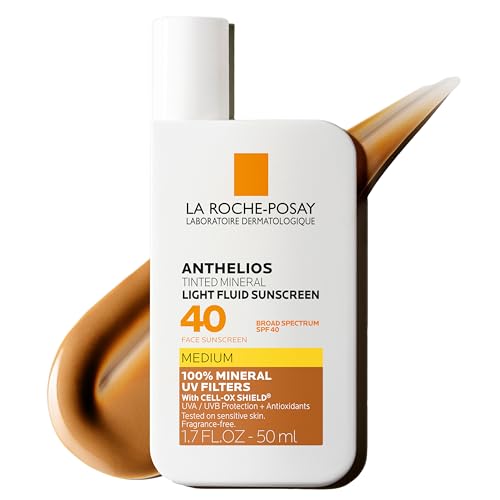
- Anthelios Tinted Mineral Sunscreen now available in 3 more flexible shades, each ideal for a broad range of skin tones, …
- Tinted mineral sunscreen for face with 100% mineral filters is formulated with iron oxides to minimize mineral white cas…
- This lightweight, non-greasy and easily blendable matte sunscreen leaves skin hydrated with a radiant, natural finish. A…
- Formula: Mineral, with titanium dioxide and zinc oxide.
- Iron oxides: Yes. The brand says they provide the tint and that research suggests they may help with visible light.
- Shades: Four (Tinted, Medium, Medium-Deep, Deep).
- SPF: One retailer lists SPF 50 for the lightest shade and SPF 40 for others. Check the exact SPF of the shade you choose.
Advantages:
- Mineral-only formula that suits sensitive skin.
- Wider shade range than most mineral options.
- A familiar dermatology brand.
Drawbacks:
- Mixed SPF across shades can confuse buyers.
- Costs more than CeraVe.
Consider it if your skin reacts easily. For more options, see our guide to sunscreens for sensitive skin. Skip it if you want a drying-down matte finish.
Best Value for Higher SPF: DRMTLGY Universal Tinted Moisturizer SPF 46
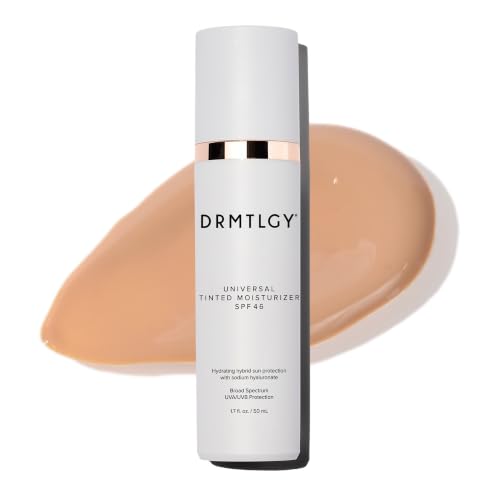
- Dewy, Radiant Tinted Sunscreen – This lightweight tinted sunscreen for face blends seamlessly into skin, delivering a he…
- Hybrid Broad Spectrum SPF 46 – Formulated with Zinc Oxide & Octinoxate, this advanced hybrid sunscreen helps protect aga…
- Hydrates, Brightens & Smooths – Niacinamide helps visibly improve uneven tone, Hyaluronic Acid supports lasting hydratio…
- Formula: Hybrid. The actives are 12% zinc oxide and 7.5% octinoxate.
- Iron oxides: Yes (CI 77492, CI 77491, CI 77499) on the labeler’s drug facts.
- Key ingredients: Niacinamide, hyaluronic acid.
- Shades: One “universal” tint.
Advantages:
- Higher zinc oxide than the EltaMD tinted formula above.
- Niacinamide and iron oxides together.
- Often positioned as a lower-cost alternative to premium brands.
Drawbacks:
- One universal shade won’t suit everyone, and deeper skin tones may notice a mismatch.
- Not mineral-only.
Consider it if you have light-to-medium skin and want SPF 46. Skip it if you need shade-matching.
Best for Dry or Mature Skin: EltaMD UV AOX Elements Tinted SPF 50

- Key hydrating sunscreen ingredients like hyaluronic acid help keep your skin soft by retaining moisture for a smoother f…
- Formula: 100% mineral. The actives are 13.5% zinc oxide and 4.4% titanium dioxide.
- Iron oxides: I couldn’t confirm them in the sources I checked. The brand claims it blocks 56% of high-energy visible (blue) light, but that is a brand claim, not an independent result.
- Key ingredients: Hyaluronic acid, antioxidants, bisabolol, and ginger root.
- Water resistance: 40 minutes.
Advantages:
- High SPF with mineral-only actives.
- Hydrating and calming ingredients.
- Water resistant for outdoor activity.
Drawbacks:
- The iron oxide content isn’t confirmed, so check the label if visible light is your priority.
- Limited shades (confirm the range).
Consider it if your skin is dry or you want antioxidants. Skip it if you need verified iron oxides.
Best Premium Option for Visible-Light Protection: Colorescience Sunforgettable Total Protection Face Shield Flex SPF 50

- TONE-ADAPTING COLOR THAT BLOOMS AS YOU BLEND: Starts white, transforms on contact. Innovative iron oxide pigments delive…
- TOTAL ENVIRONMENTAL DEFENSE SPF 50 PA++++: 100% mineral Zinc Oxide formula defends against UVA/UVB, pollution, HEV blue …
- FLEXIBLE SHADES FOR ALL SKIN TONES: Each adaptive shade delivers buildable coverage that adjusts to a wide range of skin…
- Formula: Mineral, with 12% zinc oxide.
- Iron oxides: Yes (CI 77491, CI 77492, CI 77499).
- Water resistance: 40 minutes.
- Shades: Retailers list four to six, so confirm on Amazon.
- Finish: The brand describes the finish as demi-matte, with buildable coverage.
Advantages:
- Iron oxides plus 12% zinc oxide.
- Water resistant.
- Buildable color that can work under or without foundation.
Drawbacks:
- Premium price.
- One retailer reviewer with deeper skin reported the shade looked muddy later in the day. That is one person’s experience, not a general finding.
- Limited shades compared with foundation-style tints.
Consider it if you want a premium, iron-oxide-containing mineral option. Skip it if price is a concern.
Best for Shade Variety (With a Caveat): Supergoop! Protec(tint) Daily SPF Tint SPF 50
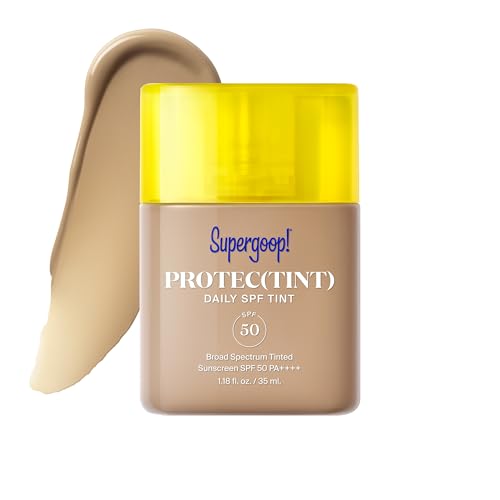
- WHAT IS IT – An effortless, lightweight skin tint meets powerful SPF 50 with light, buildable coverage & a natural finis…
- AVAILABLE IN 14 SHADES – Available in 14 flexible shades, this cushiony formula is resistant to creasing & settling & fo…
- CLINICAL RESULTS – 100% of people agree this product feels comfortable and can’t believe it has SPF 50! 95% of people ag…
- Formula: Hybrid. The actives are zinc oxide 13.58%, homosalate 7%, and octisalate 5%.
- Iron oxides: I couldn’t confirm them. Check the packaging before buying for visible-light reasons.
- Shades: Fourteen, across cool, warm, and neutral undertones.
- Size: 1.18 oz.
Advantages:
- The widest shade range here.
- Light, buildable coverage.
- SPF 50.
Drawbacks:
- Small tube for the price.
- Iron oxides unconfirmed.
- Not mineral-only.
Consider it if shade matching is your biggest challenge. Skip it if verified iron oxides are a must.
How Tinted Sunscreen Helps with Dark Spots
UVA and UVB. UVB causes burns, and UVA contributes to aging and pigmentation. The American Academy of Dermatology recommends broad-spectrum sunscreen with SPF 30 or higher.
Visible light. Standard sunscreens don’t fully address visible light, especially blue-violet light. A guide to tinted sunscreens in skin of color describes it as an underrecognized contributor to hyperpigmentation. The authors recommend iron-oxide tinted sunscreens over untinted ones for people prone to hyperpigmentation.
Iron oxides. A 2026 iron oxide and hyperpigmentation review concluded that iron oxides improve visible-light protection in pigmentation-prone skin. It also found that most tinted products don’t disclose iron oxide amounts or visible-light testing. Its advice is to look for a sunscreen containing zinc oxide and iron oxides.
A caution about “more is better.” One small 2024 comparison of four products found a formula with 1% iron oxides outperformed one with 4%. Researchers said more study is needed. Don’t assume a darker tint means better protection.
Evidence level. This research is about tinted sunscreens as a category. It isn’t about any single product above. I haven’t seen independent visible-light testing for these specific products.
How to Choose the Right Formula
- Oily or acne-prone skin: Look for lightweight, oil-free textures. No formula is guaranteed not to clog pores, so patch test.
- Dry skin: Choose hydrating options like the UV AOX Elements or CeraVe.
- Sensitive skin: Mineral-only formulas like La Roche-Posay or CeraVe are good starting points. See our sunscreens for sensitive skin guide.
- Medium, tan, and deeper skin tones: Prioritize shade range. Test shades in daylight when you can, and be cautious with single-shade products.
- Sheer coverage: CeraVe or La Roche-Posay.
- More coverage: Colorescience Flex or Supergoop Protec(tint).
- Outdoor activity: Look for water resistance, like UV AOX Elements or Colorescience Flex (40 minutes each).
For a wider look beyond tinted options, see our best sunscreens for hyperpigmentation and dark spots. If you like lightweight Asian formulas, see our comparison of popular Korean sunscreens.
How to Apply Tinted Sunscreen Correctly
- Use enough. Applying too little reduces protection, and tinted formulas tempt people to use less because they look like makeup. A common guideline is about a quarter teaspoon for the face and neck.
- Follow the label. Many say to apply about 15 minutes before sun exposure.
- Reapply about every two hours outdoors, and after swimming, sweating, or towel drying.
- Layer if needed. If the shade is too light or dark, blend carefully rather than using less.
- Add shade and clothing. Hats, sunglasses, and seeking shade add protection sunscreen can’t.
Common Mistakes
- Choosing a tint based on marketing claims alone.
- Skipping the ingredient list when visible-light protection matters.
- Buying a shade that’s too light or too dark.
- Applying too little because it feels like makeup.
- Assuming SPF foundation replaces properly applied sunscreen.
- Expecting sunscreen alone to erase existing dark spots.
Frequently Asked Questions
Is tinted sunscreen better for dark spots than untinted?
For pigmentation driven by visible light, iron-oxide tinted products have an edge according to published reviews. For UV protection alone, a well-applied untinted broad-spectrum sunscreen works.
Which ingredients should I look for?
Zinc oxide, iron oxides, and broad-spectrum UVA/UVB filters. Niacinamide is a common extra.
Does iron oxide help protect against visible light?
Research suggests yes. The amount and testing aren’t usually disclosed on products.
Can tinted sunscreen help prevent melasma from worsening?
The guide cited above says tinted sunscreens are more effective than untinted ones at preventing melasma relapses. A dermatologist should guide melasma care.
What SPF should I choose?
At least SPF 30, broad-spectrum.
Is tinted sunscreen suitable for darker skin tones?
Yes, but shade range matters. Some products offer limited shades.
Can tinted sunscreen replace foundation?
For light coverage, sometimes. It won’t match full-coverage foundation.
How often should it be reapplied?
About every two hours outdoors, and after swimming or sweating.
Does tinted sunscreen remove existing pigmentation?
No. It helps prevent worsening. Fading existing spots usually needs additional treatment from a dermatologist.
Can I use vitamin C serum under it?
Generally yes. Apply serum first and sunscreen last. See our vitamin C serums for uneven skin tone and niacinamide vs. vitamin C for acne marks.
This article isn’t individualized medical advice. See a qualified dermatologist for persistent, worsening, or hard-to-treat pigmentation.
How We Chose These Products
We started with the seven candidates in our research brief and checked ingredient lists, SPF, shades, and formula type against brand pages, retailer listings, and ingredient databases. We couldn’t open the Allure or Healthline roundups, so we didn’t rely on their rankings. We haven’t hands-on tested any product. Prices and shade counts vary by seller, so confirm on Amazon.
Final Verdict
- Best overall for acne-prone skin: EltaMD UV Clear Tinted.
- Best budget mineral: CeraVe Sheer Tint.
- Best for sensitive skin: La Roche-Posay Anthelios Tinted Mineral.
- Best higher SPF for light skin: DRMTLGY (one shade).
- Best for dry skin: EltaMD UV AOX Elements.
- Best premium: Colorescience Flex.
- Best shade variety: Supergoop! Protec(tint), once you confirm the ingredients.
Whichever you pick, apply enough and reapply. Ready to shop? Check Price on Amazon using the links above to confirm current shades and pricing.