
Petal Beauty Skincare is reader-supported. If you buy through links on our site, we may earn a commission at no extra cost to you. As an Amazon Associate, we earn from qualifying purchases.
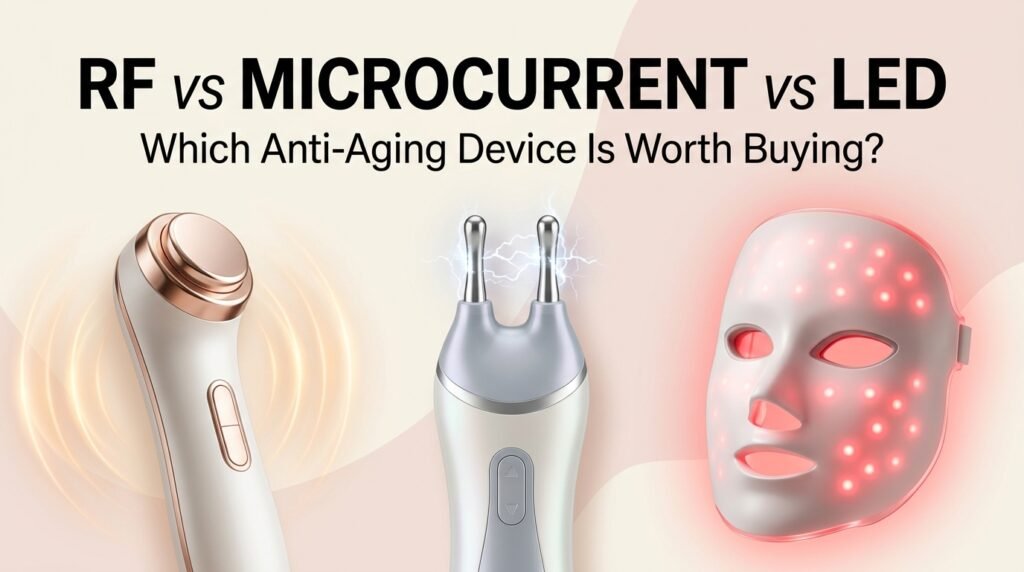
If you’ve searched “RF vs microcurrent vs LED,” you’ve probably noticed that all three are sold as anti-aging technology. That’s why shopping feels confusing. They work in different ways and suit different concerns, so one is not simply a stronger version of another.
The better question isn’t “which technology is best?” It’s “which technology matches my main skin concern?” Sagging, fine lines, dullness and acne each point to a different starting place.
This guide is a buyer’s guide, not a science lecture. It covers what each technology does, what the evidence can and can’t tell us, what it costs to own, and how to avoid spending $200–$600 on the wrong device.
Quick Comparison: RF vs Microcurrent vs LED
| Technology | Best For | How It Works | Typical Session | Typical Price Range* | Main Limitation |
|---|---|---|---|---|---|
| RF | Firmness, mild laxity | Heats skin tissue to support collagen remodeling | About 5–10 min per area, often weekly | ~$150–$500 | Gradual, modest results; gel and time needed |
| Microcurrent | Toning, contour, temporary lifted look | Low-level electrical stimulation | About 5 min, several times a week at first | ~$100–$400 | Needs frequent, consistent use; long-term effects less clear |
| LED | Fine lines, tone, overall skin quality | Specific light wavelengths | About 10–20 min, several times a week | ~$100–$600+ | Slow; quality varies widely between masks |
Approximate 2026 ranges. Amazon prices change, so check the current listing.
Which Technology Fits Which Concern?
| Skin Concern | RF | Microcurrent | LED |
|---|---|---|---|
| Fine lines | Possible | Possible, modest | Commonly targeted (red/NIR) |
| Wrinkles | Modest | Modest | Modest, gradual |
| Mild sagging | Commonly investigated | Modest | Not the main mechanism |
| Jawline definition | Commonly investigated | Commonly investigated | Not a focus |
| Facial contour | Some | Main focus | Not a focus |
| Dullness | Some | Some | Commonly targeted |
| Uneven texture | Some | Limited | Commonly targeted |
| Redness | Use caution | Limited | Some evidence for red light |
| Acne | Not a focus | Not a focus | Blue (and some red) LED |
| Quick temporary lift | Not typical | Most associated | Not typical |
| Long-term maintenance | Periodic sessions | Ongoing sessions | Ongoing sessions |
This is not a scientific ranking. “Commonly targeted” means the technology is usually marketed and studied for that concern. It doesn’t mean results are guaranteed.
What Is Radio Frequency (RF)?
RF uses controlled electromagnetic energy to create heat in the skin. At-home RF aims to warm tissue enough to support collagen remodeling over time. Results build gradually, and they’re modest.
Home devices operate at lower energy than professional treatments. That makes safety features matter: temperature monitoring, contact sensors, approved treatment areas and following the manufacturer’s instructions. Many devices need a conductive gel.
For example, CurrentBody says its Skin RF aims to keep skin in a 40–43°C range using temperature sensing. It also lists FDA clearance on its site. Those are company claims, not independent proof.
RF is often considered when firmness and mild laxity are the main concern. Realistic expectations:
- No surgical-level tightening
- No dramatic overnight change
- Consistent use matters more than a single session
If you’re shopping in this category, see our guide to the best at-home radio frequency devices for skin tightening for specifications and product examples.
What Is Microcurrent?
Microcurrent uses very low-level electrical stimulation. It’s mainly marketed for facial toning, contour and a lifted appearance.
The important distinction is between immediate, temporary changes (a fresher, more toned look right after a session) and longer-term results, which are harder to verify and depend on continued use. Microcurrent should not be described as permanently rebuilding facial structure.
Most devices need a conductive gel or activator so the current travels across the skin. Technique matters, too. Sloppy passes or too little gel can mean a weaker experience.
NuFACE TRINITY+ is a recognizable example. According to NuFACE, its devices are FDA-cleared, and the brand’s guidance has been about five minutes a day, five days a week at first, then two to three times weekly for maintenance. Check the current instructions for your model. For a closer look, read our NuFACE TRINITY+ review, or browse microcurrent devices for wrinkles and facial toning.
What Is LED Light Therapy?
LED masks use specific wavelengths of light, an approach called photobiomodulation. The American Academy of Dermatology describes red and near-infrared light as used for signs of aging, and notes that in-office red light is stronger than what home devices deliver.
- Red light is commonly used for fine lines and skin rejuvenation.
- Near-infrared (NIR) is often added for deeper light penetration.
- Blue light is generally used for acne, not anti-aging.
Three terms are worth knowing in plain language:
- Wavelength: the “color” of light, measured in nanometers. Check that a mask lists exact wavelengths.
- Irradiance: how strong the light is at the skin. Higher isn’t automatically better, but it shapes how long a session should be.
- Treatment time: how long you need to wear it. Weak light plus short time is not the same as the dose a study tested.
Don’t judge a mask only by its LED count. Wavelengths, irradiance, fit and coverage matter more. LED also doesn’t work through the same mechanism as RF, and it needs repeated sessions over weeks.
RF vs Microcurrent vs LED: What Is Actually Different?
Think of it this way:
- RF = heat + dermal/firmness focus
- Microcurrent = low-level electrical stimulation + toning/contour
- LED = light + skin quality/photobiomodulation
They aren’t tiers of the same technology. A $500 LED mask won’t give you RF-style heat, and a microcurrent wand won’t behave like a light mask. Buying “the strongest” one misses the point. Matching the mechanism to your concern is what counts.
Which Technology Makes Sense for Your Main Concern?
If Your Main Concern Is Sagging Skin or Jowls
RF is often the category shoppers investigate first because it targets firmness. Microcurrent may appeal if you mainly want toning and contour. Either way, at-home results for sagging are modest. Devices such as CurrentBody Skin RF, TriPollar STOP Vx or NEWA are worth researching. Their limits are cost, session time and gradual results.
If Your Main Concern Is Facial Contour or a Temporary Lift
Microcurrent is the natural fit. Many people like the short sessions and the immediate “toned” look. The trade-off is that you’ll likely need regular use to maintain it. NuFACE MINI+ is a smaller, travel-friendly option to research, but a smaller device generally means smaller treatment areas.
If Your Main Concern Is Fine Lines and Overall Skin Quality
LED is worth considering, especially red/NIR masks. RF is also relevant if loss of firmness is part of the picture. See our 7 best LED face masks for wrinkles and anti-aging for comparisons.
If Your Main Concern Is Dullness or Uneven Tone
LED is the most logical place to start, since it’s aimed at overall skin quality rather than lifting. The AAD notes that research suggests red light may help with texture and redness, though results vary.
If Your Main Concern Is Acne + Aging
Red/NIR LED and blue LED address different things. Blue is generally used for acne; red/NIR for aging. Before buying, confirm exactly which wavelengths your mask includes. A “multi-color” mask may not have the specific ones you want.
If You Want the Lowest-Maintenance Routine
Hands-free LED masks are usually the easiest to stick with: put it on, relax, take it off. RF and microcurrent need gel and active handling. Premium masks like CurrentBody Skin LED and iRestore Illumina may be more comfortable, which helps consistency, though comfort doesn’t prove better results.
Which Has the Strongest Evidence?
Honestly, evidence for home beauty devices is still uneven. A 2024 systematic review looked at 18 clinical studies of home devices using RF, microcurrent and LED. It concluded that these devices may improve skin aging to a certain extent, with mostly transient redness and swelling reported. It also flagged limited research, small sample sizes and short follow-up periods.
Things to keep in mind:
- Studies are often small.
- Follow-up can be short, so we know little about lasting results.
- Different devices and protocols make direct comparisons hard.
- Some device studies are funded by manufacturers, so check who paid for the research.
Here’s the key distinction:
- Evidence for the technology (RF, microcurrent or LED can have measurable effects in some studies)
- Evidence for this specific consumer device (does this model, at this power, on this schedule, work?)
The first doesn’t automatically prove the second. When a brand cites a study, check whether it tested the same device you’re buying.
At-Home vs Professional Treatments
Consumer devices are designed for safety in untrained hands, so they generally run at lower energy than professional equipment.
- Home RF is not equivalent to professional RF.
- Home LED is not equivalent to every professional LED treatment.
- Home microcurrent shouldn’t be compared to clinical procedures.
- Significant sagging, deep wrinkles or major structural concerns may call for a professional evaluation.
At-home devices are better thought of as maintenance and gradual-improvement tools, not replacements.
What Does Each Technology Cost?
These are approximate 2026 ranges. Amazon prices change, so check the current listing.
| Cost Factor | RF | Microcurrent | LED |
|---|---|---|---|
| Device | ~$150–$500 | ~$100–$400 | ~$100–$600+ |
| Gel/consumables | RF gel, sometimes proprietary | Conductive gel/activator, ongoing | Usually none |
| Frequency | Often weekly, then maintenance | Several times a week at first | Several times a week |
| Accessories | Varies | Attachments, lip/eye tools | Eye protection, neck pieces |
| Time | Higher per session | Short but frequent | Passive but long |
For reference, CurrentBody lists its Skin RF at roughly $385 on its U.S. site, but pricing varies by retailer and promotion. Premium microcurrent and LED prices vary too, so verify before buying.
The cheapest device isn’t always the cheapest to own over 12 months. A budget microcurrent tool that needs pricey proprietary gel, or a device with a short warranty, can cost more than expected. Check warranty length, replacement gel costs and whether accessories are included.
What Should You Look For Before Buying?
RF
- Real RF specifications (not just “warming”)
- Temperature control
- Skin-contact sensors and automatic shutoff
- Approved treatment areas
- Clear instructions and regulatory information
Microcurrent
- Intensity/settings
- Conductive gel requirements and ongoing cost
- Treatment time and supported facial areas
- Manufacturer instructions and warranty
LED
- Exact wavelengths
- Irradiance, if the brand shares it
- Treatment time, face coverage and fit
- Eye protection
- FDA clearance where applicable
- Manufacturer safety instructions
A note on “FDA-cleared.” Under the FDA’s 510(k) process, a device is cleared by showing it’s substantially equivalent to a legally marketed device. That’s different from FDA approval, and it doesn’t mean the FDA guarantees dramatic anti-aging results. Also, “FDA-registered” is not the same as “FDA-cleared.” Verify clearance claims for the specific model you’re buying.
Can You Combine RF, Microcurrent and LED?
Some people use more than one technology because they address different concerns:
- LED + microcurrent: skin quality plus toning
- RF + LED: firmness plus overall skin quality
- Multi-function devices: one device with several modes, like the Medicube Age-R Booster Pro. See our Medicube Age-R Booster Pro vs NuFACE TRINITY+ comparison, and NuFACE vs Solawave for another multi-technology angle.
Combining doesn’t automatically mean better results. Evidence for specific combinations is generally thinner than for each technology alone. Follow each manufacturer’s instructions, and don’t build an aggressive routine just because you own three devices. If your skin gets irritated, scale back.
The Hidden Cost of Consistency
Every technology here depends on regular use, but the effort looks different:
- RF: More time-intensive, usually needs gel, repeated sessions.
- Microcurrent: Short sessions but frequent use and conductive product.
- LED: Usually hands-free, but requires repeated sessions over weeks.
A device you use consistently can be more useful than a technically impressive one that stays in a drawer. Be honest about your routine. If you know you won’t apply gel five nights a week, an LED mask may be the smarter buy, even if RF sounds more exciting.
Best Device Category by Goal
- Mild skin laxity: RF
- Facial toning and contour: Microcurrent
- Fine lines and overall skin quality: Red/NIR LED
- Acne plus anti-aging concerns: LED with the appropriate wavelengths
- Multiple technologies: A multi-mode device, but verify what each mode actually does
For premium LED comparisons, see Omnilux vs CurrentBody vs Shark CryoGlow and our iRestore Illumina review. Check the current Amazon listing for pricing and availability.
5 Common Mistakes When Buying an At-Home Anti-Aging Device
- Buying based only on price. Cheap “RF” devices may only warm the skin. Verify specifications.
- Confusing FDA registration with FDA clearance. They mean different things.
- Assuming more LEDs means better. Wavelength, irradiance and fit matter more.
- Expecting professional-treatment results. Home devices are gentler by design.
- Ignoring treatment frequency and ongoing costs. Gel, time and accessories add up.
Frequently Asked Questions
Is RF better than microcurrent for sagging skin?
They target different things. RF is more often investigated for firmness and mild laxity; microcurrent for toning and contour. Home results are modest for both.
Is LED better than RF for wrinkles?
Neither is clearly “better.” LED is commonly used for fine lines and skin quality; RF for firmness. LED vs RF for wrinkles depends on whether your concern is surface texture or looseness.
Can I use microcurrent and LED together?
Some people do, since the mechanisms differ. Follow each manufacturer’s instructions, and note that combined-use evidence is limited.
Can I use RF and LED together?
Some people do, but there’s little evidence for specific combinations. Don’t stack sessions aggressively, and check both manuals.
Which device is best for jawline definition?
Microcurrent and RF are the categories most often investigated for jawline and contour. Expect subtle changes.
Do at-home RF devices really tighten skin?
Some studies suggest modest improvements, but results are gradual and less than professional treatments. Evidence for any specific device varies.
Does microcurrent permanently lift the face?
No. Immediate effects are generally described as temporary, and maintaining them requires continued use.
How long does LED take to show results?
Typically weeks to months of regular use. The AAD notes that consistency is required.
Are at-home anti-aging devices safe?
Most are designed for home use when instructions are followed, but they aren’t risk-free. Skip devices if you have contraindications listed by the manufacturer, and ask a doctor if you’re unsure.
How much should I spend on an anti-aging device?
There’s no magic number. A well-specified device you’ll use often beats an expensive one you won’t. Compare total ownership cost, not just the sticker price.
Conclusion
There’s no single winner in the RF vs microcurrent vs LED debate.
- RF makes sense to investigate when firmness and mild laxity are the main concern.
- Microcurrent fits when facial toning and contour are the priority.
- LED fits when fine lines, skin quality, tone and a low-effort routine matter most.
If you have multiple concerns, a combination or multi-mode device may be worth investigating. Just verify what each technology actually does, and don’t assume more modes means better results.
Choose the technology that matches your biggest concern, your budget and the routine you can realistically maintain.