
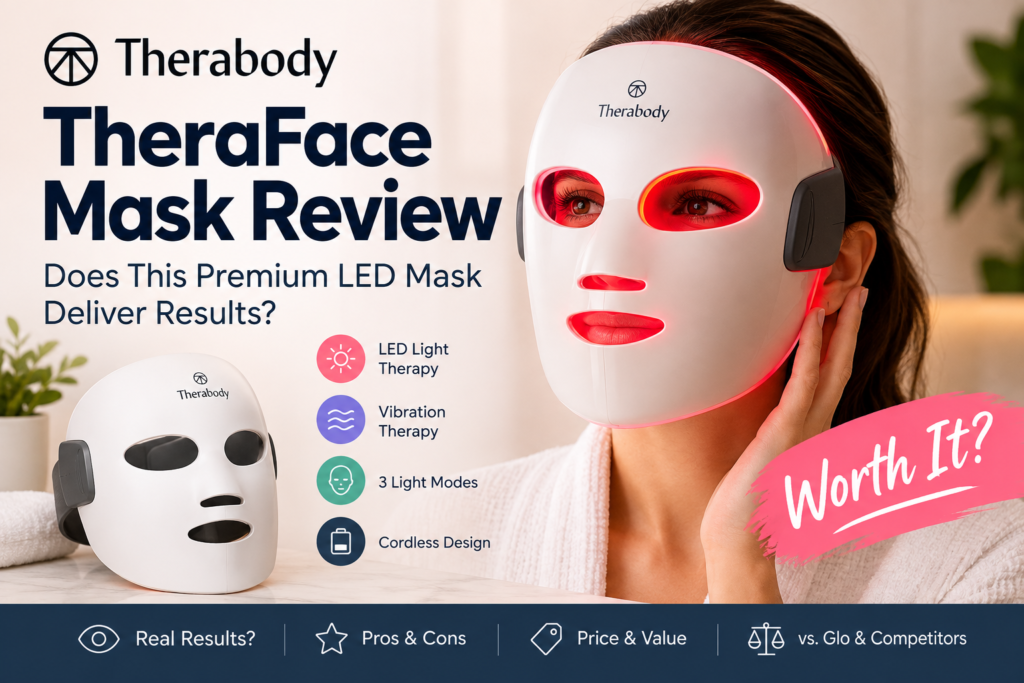
If you’ve spent any time researching LED face masks, you’ve probably landed on the Therabody TheraFace Mask review pages more than once. It’s one of the most talked-about masks in the premium category, thanks to its 648 LEDs, three light wavelengths, and a built-in vibration feature you don’t see on most competitors. But at $599.99, it’s also one of the biggest skincare purchases most people will make. This guide breaks down how the TheraFace Mask actually works, what the evidence says about results, how it compares to the newer TheraFace Mask Glo and other premium masks, and who should (and shouldn’t) spend the money.
Quick Summary
| Product | Therabody TheraFace Mask |
| Best For | Fine lines, firmness, full-face coverage, multitaskers |
| Light Types | Red (633nm), Red + Infrared (633/830nm), Blue (415nm) |
| LED Count | 648 |
| Treatment Time | 3–9 minutes (9-minute preset cycle) |
| Approx. Price | Check current price (list price around $599–$650) |
| FDA Status | FDA-cleared, Class II medical device |
| Key Advantage | High LED density, three wavelengths in one device, cordless |
| Biggest Drawback | Premium price, rigid heavy shell, no app control |
| Overall Value | Strong for buyers who want an all-in-one device; harder to justify on a tight budget |
Check Price on Amazon
TheraFace Mask at a Glance
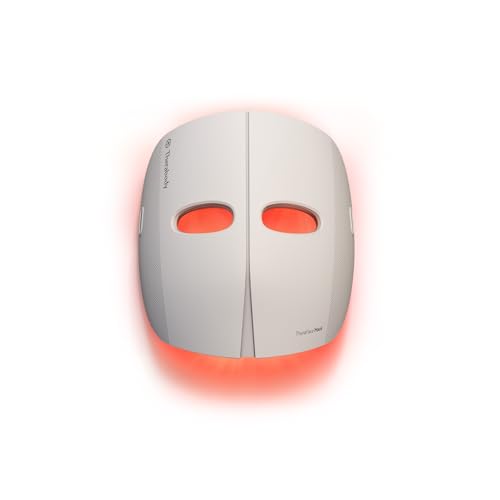
- Supercharged Face Care in 9 Minutes: A facial mask routine with 3 impressive LED light therapy technologies. Red light t…
- Vibrating Facial Massager, Too: TheraFace LED mask delivers a 15-minute vibration therapy treatment to key pressure poin…
- Powerful, Medical-Grade Lights: With 3x more LEDs than leading mask competitors for maximum efficacy and mask skincare r…
The TheraFace Mask is Therabody’s first foray into LED skincare, built by the same company behind the Theragun percussion massagers. It’s a rigid, helmet-style mask that straps onto your head and delivers red, red-plus-infrared, and blue light across your entire face in a single, cordless session. It also has a built-in vibration feature, which is unusual in this category.
It isn’t the only mask Therabody makes. The company later released the TheraFace Mask Glo, a lighter, lower-priced version with fewer LEDs. We’ll get into that comparison in detail later, but it’s worth flagging up front: this review is specifically about the original TheraFace Mask, not the Glo.
What Is the Therabody TheraFace Mask?
- Supercharged Face Care in 9 Minutes: A facial mask routine with 3 impressive LED light therapy technologies. Red light t…
- Vibrating Facial Massager, Too: TheraFace LED mask delivers a 15-minute vibration therapy treatment to key pressure poin…
- Powerful, Medical-Grade Lights: With 3x more LEDs than leading mask competitors for maximum efficacy and mask skincare r…
At its core, the TheraFace Mask is an LED light therapy device that uses red, near-infrared, and blue wavelengths to target common skin concerns like fine lines, uneven tone, and acne-causing bacteria. What sets it apart from a lot of ordinary LED masks is that each of its 648 LEDs can reportedly produce all three wavelengths, rather than splitting the lights into separate zones by color. Therabody says this design allows for more even coverage across the whole face, including areas some flexible masks struggle to treat consistently, like around the eyes and jawline.
It’s also a Class II, FDA-cleared medical device, which puts it in the same regulatory category as other reputable at-home LED masks. FDA clearance for a device like this speaks to safety, not to a guarantee of specific cosmetic results — that distinction matters and we’ll come back to it.
If you’re comparing multiple masks side by side, our guide to the 7 Best LED Face Masks for Wrinkles and Anti-Aging is a good place to see how this one stacks up against other well-reviewed options.
How the TheraFace Mask Works
- Supercharged Face Care in 9 Minutes: A facial mask routine with 3 impressive LED light therapy technologies. Red light t…
- Vibrating Facial Massager, Too: TheraFace LED mask delivers a 15-minute vibration therapy treatment to key pressure poin…
- Powerful, Medical-Grade Lights: With 3x more LEDs than leading mask competitors for maximum efficacy and mask skincare r…
The mask combines a few different technologies:
- Red light is intended to work on the more superficial layers of skin to support collagen production and soften the look of fine lines.
- Red + near-infrared light penetrates a bit deeper and is generally associated with firmness and smoother texture.
- Blue light targets the surface of the skin and is commonly used to help manage acne-causing bacteria.
- Vibration therapy, delivered through 17 built-in motors, is marketed as a way to ease facial tension and boost circulation around the eyes, browline, and scalp — more of a relaxation add-on than a core skincare treatment.
- 648 LEDs distributed across the mask are meant to provide dense, even light coverage over the entire face rather than concentrated spots.
- Full-face coverage includes the eye and mouth areas, which is a common weak spot for flexible, fabric-style masks.
In plain terms: you put the mask on, pick a light mode (or let it run the full preset cycle), and let it do its thing hands-free for a few minutes while the LEDs and, optionally, the vibration motors work at the same time.
TheraFace Mask Wavelengths Explained
Wavelength matters because different wavelengths of light penetrate the skin to different depths and interact with different biological processes. The TheraFace Mask uses three:
- Red light, around 633nm — associated with supporting collagen synthesis and reducing the appearance of fine lines and dark spots.
- Near-infrared, around 830nm — penetrates further into the skin and is typically paired with red light to support firmness and deeper collagen remodeling.
- Blue light, around 415nm — works at the skin’s surface and is associated with reducing acne-causing bacteria.
It’s worth being clear-eyed here: having the “right” wavelength is necessary but not sufficient for results. Wavelength alone doesn’t guarantee outcomes — dose, consistency, treatment time, and the intensity of light delivered (irradiance) all play a role too, which is part of why LED devices at similar wavelengths can still perform differently in practice.
Does the TheraFace Mask Actually Work?
- Supercharged Face Care in 9 Minutes: A facial mask routine with 3 impressive LED light therapy technologies. Red light t…
- Vibrating Facial Massager, Too: TheraFace LED mask delivers a 15-minute vibration therapy treatment to key pressure poin…
- Powerful, Medical-Grade Lights: With 3x more LEDs than leading mask competitors for maximum efficacy and mask skincare r…
This is the question everyone actually wants answered, so let’s separate what Therabody says from what the independent evidence actually supports.
What the manufacturer claims: Therabody markets the TheraFace Mask as clinically proven to improve the appearance of fine lines, firmness, and skin tone, based on a 12-week clinical study it commissioned. That study involved 31 participants using the preset 9-minute treatment once a day for 12 weeks.
What independent evidence suggests: A 31-person study is small, and it was run by a third-party lab on behalf of the manufacturer rather than published in an independent, peer-reviewed journal. That doesn’t mean the results are meaningless, but it does mean they should be read as a company-sponsored trial on a modest sample size, not as definitive proof that works for everyone. Broader scientific literature on home-use LED and light-based devices generally supports the idea that red and near-infrared light therapy can produce modest, gradual improvements in skin texture and fine lines with consistent use, though outcomes vary a lot from person to person and tend to be more incremental than dramatic. A 2026 review of home-use dermatologic devices and an earlier review of LED skin therapy research both point in the same direction: LED therapy is generally considered safe and can offer real, if modest, benefits, but it works through cumulative, gradual change rather than a single dramatic transformation.
The practical takeaway: LED results are typically gradual and depend heavily on how consistently you actually use the device. Skipping sessions or expecting a two-week glow-up is where most people end up disappointed.
My Take on the Expected Results
Based on the clinical data available and the broader evidence on LED light therapy, here’s a realistic breakdown of what to expect:
- Fine lines: Some visible softening is plausible with consistent use over 8–12 weeks, though not elimination.
- Wrinkles: Deeper wrinkles are less likely to change dramatically; expect subtle improvement at best.
- Firmness: This is one of the more commonly reported benefits in LED mask studies generally, including Therabody’s own.
- Skin tone: Gradual improvements in evenness are reasonably well supported.
- Dark spots: Some reduction is possible over time, but LED masks are not a substitute for treatments specifically designed for pigmentation.
- Radiance: This is one of the more frequently reported subjective benefits from users of LED masks in general.
- Acne: Blue light can help with acne-causing bacteria on the surface, but according to the American Academy of Dermatology, light-based treatments alone rarely clear acne completely and results vary significantly from person to person; visible light in particular doesn’t treat blackheads, whiteheads, cysts, or nodules.
None of this happens overnight. If you’re buying this mask expecting a dramatic transformation within a week or two, you’re likely to be disappointed regardless of how good the device is.
TheraFace Mask Features
- 648 medical-grade LEDs spread across the full mask
- 3 light modes: red, red + infrared, and blue, which can be used individually or as part of a full cycle
- Vibration therapy via 17 built-in motors, adjustable and optional
- Cordless design for hands-free, walk-around use
- Treatment duration ranging from 3 to 9 minutes, with a 9-minute preset cycle
- Removable protective eye shields included
- Battery life of roughly 120 minutes in LED mode and 60 minutes in vibration mode
- Weight of about 576g on its own, or 636g with the stand attached
- Manual controls on the mask itself rather than a smartphone app
- Full-face coverage, including around the eyes and mouth
Is the 648-LED Count Really Better?
- Supercharged Face Care in 9 Minutes: A facial mask routine with 3 impressive LED light therapy technologies. Red light t…
- Vibrating Facial Massager, Too: TheraFace LED mask delivers a 15-minute vibration therapy treatment to key pressure poin…
- Powerful, Medical-Grade Lights: With 3x more LEDs than leading mask competitors for maximum efficacy and mask skincare r…
Therabody leans hard on the “648 LEDs” number in its marketing, and it’s a legitimately high count compared to many competitors. But LED count by itself doesn’t tell the whole story, and it’s worth understanding why.
More LEDs generally means denser, more even coverage across the face — fewer gaps between light sources. That’s a real advantage. What LED count does not automatically tell you is the irradiance (the intensity of light hitting your skin per square centimeter), the dose (total light energy delivered over a session), or how those factors interact with treatment time. A mask with fewer, more powerful LEDs and a longer session could theoretically deliver a comparable or even higher total dose than a mask with more LEDs and a shorter session. Therabody has stated a power density target in the range of roughly 55 mW/cm² for the original TheraFace Mask, but it doesn’t publish detailed irradiance specs on the same terms competitors like CurrentBody do, which makes precise apples-to-apples comparisons difficult.
The honest answer is that 648 LEDs is a genuine engineering advantage for even coverage, but it isn’t proof on its own that the mask outperforms every mask with a lower LED count. Coverage, wavelength accuracy, dose, and consistent use all matter together.
What I Like About the TheraFace Mask
- Fast sessions — the 9-minute preset is easy to fit into a daily routine
- Three wavelengths in a single device, so you’re not buying separate tools for anti-aging and acne concerns
- Genuinely full-face coverage, including the eye and mouth areas
- Cordless design means you can move around during treatment
- The vibration feature adds a relaxing, spa-like element that some users find genuinely enjoyable
- Backed by an established brand with a track record in recovery and wellness tech
- FDA-cleared as a Class II medical device
What I Don’t Like
- The price is genuinely premium, and there’s no getting around that
- The hard-shell, helmet-style design is heavier than flexible fabric masks, and some users find it uncomfortable for longer sessions
- There’s no detailed battery percentage indicator, just an approximate life estimate
- Unlike the newer Glo, the original mask is controlled with physical buttons rather than a companion app
- Some users report the mask gets slightly warm during longer or back-to-back sessions
- There’s no neck attachment or dedicated neck treatment mode, which some competing systems offer as an add-on
- Blue light exposure is something people prone to hyperpigmentation or melasma may want to use more cautiously
- Not everyone will notice dramatic results, and Therabody’s own study reflects a fairly small sample size
TheraFace Mask vs TheraFace Mask Glo
- Supercharged Face Care in 9 Minutes: A facial mask routine with 3 impressive LED light therapy technologies. Red light t…
- Vibrating Facial Massager, Too: TheraFace LED mask delivers a 15-minute vibration therapy treatment to key pressure poin…
- Powerful, Medical-Grade Lights: With 3x more LEDs than leading mask competitors for maximum efficacy and mask skincare r…
This is one of the most common points of confusion, so here’s a direct comparison.
| TheraFace Mask (Original) | TheraFace Mask Glo | |
|---|---|---|
| LED Count | 648 | 504 |
| Treatment Time | 3–9 minutes (9-min preset) | 12-minute preset |
| Design | Rigid shell, heavier (576g) | Rigid shell, lighter (around 514g) |
| Comfort | Bulkier fit | Marketed as a lighter, more streamlined fit |
| Wavelengths | Red (633nm), Red+IR (633/830nm), Blue (415nm) | Same three wavelengths |
| Vibration | 17 motors targeting face and scalp pressure points | Vibration focused mainly on the scalp |
| Intended User | Buyers who want maximum LED density and shorter sessions | Buyers who want a lighter, simpler, lower-cost option |
| Price/Value | Higher price (~$599–$650) | Lower price (~$380–$390) |
The original TheraFace Mask has significantly more LEDs and a shorter treatment time, along with more extensive vibration targeting. The Glo trades some of that LED density and vibration coverage for a lighter mask, a lower price, and a longer but still simple 12-minute session. Therabody’s own clinical study for the Glo used a larger sample of 104 participants over 12 weeks, compared to 31 for the original — worth noting if clinical sample size matters to you.
Neither one is universally “better.” If you want the highest LED density, the shortest sessions, and more extensive vibration therapy, the original makes more sense. If you’re mainly looking for a more affordable, lighter entry point into LED masking and don’t mind a slightly longer session, the Glo is worth considering instead.
TheraFace Mask vs Other Premium LED Masks
- CurrentBody Skin LED Mask Series 2: CurrentBody includes a third, deeper near-infrared wavelength around 1072nm that the TheraFace Mask doesn’t offer, and it publishes clearer irradiance figures. It’s priced in a similar premium range but uses a flexible silicone design rather than a rigid shell.
- Omnilux Contour: Omnilux has one of the longest clinical research histories in this category and uses a simpler two-wavelength (red and near-infrared) approach without a blue light or vibration option. It’s typically priced somewhat lower than the TheraFace Mask.
- Dr. Dennis Gross SpectraLite FaceWare Pro: This is another rigid-style mask with red and blue light and notably short, roughly 3-minute sessions, generally priced below the TheraFace Mask.
- Shark CryoGlow: A newer entrant that combines red, blue, and deep infrared light with a built-in under-eye cooling feature, and is priced meaningfully lower than the TheraFace Mask.
The main trade-offs across this category tend to come down to LED density and vibration (where TheraFace leads), deeper near-infrared wavelengths and published irradiance data (where CurrentBody leads), treatment history and simplicity (Omnilux), session speed (Dr. Dennis Gross), and price plus extra features like cooling (Shark). None of these has a dramatically different underlying mechanism — they all rely on similar red/near-infrared/blue light principles — so the decision usually comes down to comfort, price, and which extra features matter to you.
Who Should Buy the TheraFace Mask?
- Supercharged Face Care in 9 Minutes: A facial mask routine with 3 impressive LED light therapy technologies. Red light t…
- Vibrating Facial Massager, Too: TheraFace LED mask delivers a 15-minute vibration therapy treatment to key pressure poin…
- Powerful, Medical-Grade Lights: With 3x more LEDs than leading mask competitors for maximum efficacy and mask skincare r…
- Someone primarily focused on fine lines and firmness who wants a well-rounded, three-wavelength device
- Someone who values having red, near-infrared, and blue light all built into a single mask instead of buying separate tools
- Someone who wants a genuinely cordless, hands-free experience
- Someone who appreciates the built-in vibration/relaxation feature as part of their routine
- Someone comfortable spending close to $600 on a long-term skincare investment
Who Should Skip It?
- Supercharged Face Care in 9 Minutes: A facial mask routine with 3 impressive LED light therapy technologies. Red light t…
- Vibrating Facial Massager, Too: TheraFace LED mask delivers a 15-minute vibration therapy treatment to key pressure poin…
- Powerful, Medical-Grade Lights: With 3x more LEDs than leading mask competitors for maximum efficacy and mask skincare r…
- Anyone who prefers a lightweight, flexible mask they can fold flat for storage
- Anyone who wants smartphone app control and tracking (consider the Glo or a competitor instead)
- Anyone specifically looking for neck and décolletage coverage
- Anyone working with a noticeably smaller skincare device budget
- Anyone expecting fast, dramatic, guaranteed transformation rather than gradual, consistency-dependent change
How to Use the TheraFace Mask
- Start with clean, dry skin, free of makeup or heavy product.
- Put on the mask and adjust the straps for a snug, comfortable fit.
- Choose the light mode appropriate for your main concern, or run the full preset cycle.
- Complete the recommended 9-minute treatment, using the protective eye shields.
- Follow up with your regular skincare routine, such as a serum or moisturizer.
Safety and Who Should Be Careful
The TheraFace Mask is an FDA-cleared Class II medical device, which reflects a baseline safety standard, but that doesn’t mean it’s automatically appropriate for everyone. People with photosensitivity, certain skin conditions, those taking medications that increase light sensitivity, or those with eye conditions should check with a healthcare professional before use and should carefully follow Therabody’s stated contraindications and instructions. If you’re prone to melasma or hyperpigmentation, it’s worth being cautious with blue light specifically.
On the acne side, it’s worth setting realistic expectations. According to the American Academy of Dermatology, at-home visible-light LED devices are generally less powerful than the tools dermatologists use in-office, results vary significantly from person to person, and visible light can help with active pimples but doesn’t address blackheads, whiteheads, cysts, or nodules. If you’re dealing with more complex acne or acne-related discoloration, it may also help to look into ingredient-based options; our comparison of niacinamide vs vitamin C for acne marks covers two commonly recommended approaches.
This isn’t personalized medical advice — if you have any underlying condition or are unsure whether LED therapy is appropriate for you, talk to a dermatologist or your doctor first.
Is the Therabody TheraFace Mask Worth It?
- Supercharged Face Care in 9 Minutes: A facial mask routine with 3 impressive LED light therapy technologies. Red light t…
- Vibrating Facial Massager, Too: TheraFace LED mask delivers a 15-minute vibration therapy treatment to key pressure poin…
- Powerful, Medical-Grade Lights: With 3x more LEDs than leading mask competitors for maximum efficacy and mask skincare r…
It may make sense for buyers who value having multiple wavelengths, dense LED coverage, a relaxing vibration feature, and a cordless design all combined into one premium device, and who are prepared to use it consistently for months to see gradual results.
It may not make sense for buyers who prioritize a lower price point, a lighter and more packable design, app-based tracking, or who are hoping for fast, guaranteed results rather than a gradual skincare investment.
At close to $600, this device sits firmly in premium territory. You’re paying for LED density, brand reputation, and the convenience of getting three light therapies in one hands-free tool — not for a guarantee that it will outperform every other mask on the market. Whether that’s worth it comes down to your budget, how much you value the extra features, and how realistic your expectations are about what LED therapy can do.
If you decide this isn’t the right fit, it’s also worth pairing whatever device you choose with solid daily sun protection, since UV damage is one of the biggest drivers of visible aging that no LED mask can undo; our best sunscreens for sensitive skin guide is a good place to start.
Final Verdict
The Therabody TheraFace Mask is a well-built, FDA-cleared LED device that genuinely delivers on its core promise: dense, full-face coverage across three wavelengths in a fast, cordless session, backed by a company-run clinical study that’s real but modest in scale. It’s not going to reverse aging or clear acne on its own, and it comes at a steep price. But for someone who wants an all-in-one LED and vibration device, is willing to commit to consistent use over months, and has the budget for a premium purchase, it’s a reasonable pick in a crowded category. If your budget is tighter or you’d rather have app control and a lighter mask, the TheraFace Mask Glo or one of its direct competitors may be the smarter choice.
See Today’s Price
Frequently Asked Questions
- Supercharged Face Care in 9 Minutes: A facial mask routine with 3 impressive LED light therapy technologies. Red light t…
- Vibrating Facial Massager, Too: TheraFace LED mask delivers a 15-minute vibration therapy treatment to key pressure poin…
- Powerful, Medical-Grade Lights: With 3x more LEDs than leading mask competitors for maximum efficacy and mask skincare r…
Is the TheraFace Mask worth the money? It can be worth it for people who want a high LED count, multiple wavelengths, and a vibration feature in one cordless device, and who plan to use it consistently. It’s a harder sell for anyone on a tighter budget or expecting fast, dramatic results.
How long does it take to see results from TheraFace Mask? Therabody’s clinical study reported improvements as early as 8 weeks, based on daily use over a 12-week period. Independent reviewers generally describe LED results as gradual rather than immediate.
How often should you use the TheraFace Mask? Therabody’s clinical protocol used the preset 9-minute treatment once a day. Consistency appears to matter more than any single session.
Does TheraFace Mask help with wrinkles? Published reviews and Therabody’s own study suggest it may help soften the appearance of fine lines and support firmness with consistent use, though it’s unlikely to eliminate deeper wrinkles.
Does TheraFace Mask help acne? The blue light setting is designed to target acne-causing bacteria on the skin’s surface. Per the American Academy of Dermatology, at-home LED devices are generally less powerful than in-office treatments, and they only address pimples, not blackheads, whiteheads, cysts, or nodules.
Is TheraFace Mask safe for sensitive skin? It’s FDA-cleared as a Class II device, but anyone with photosensitivity, certain medical conditions, or a history of melasma should check with a healthcare provider before use and follow the manufacturer’s contraindications.
What is the difference between TheraFace Mask and TheraFace Mask Glo? The original TheraFace Mask has 648 LEDs, a shorter 9-minute preset, and more extensive vibration targeting across the face and scalp. The Glo has 504 LEDs, a 12-minute preset, a lighter design, and vibration focused mainly on the scalp — at a noticeably lower price.
How many LEDs does the TheraFace Mask have? 648 medical-grade LEDs, each reportedly capable of producing all three light wavelengths (red, red + infrared, and blue).
Meta Information
SEO Title: Therabody TheraFace Mask Review: Worth the Price?
Meta Description: An honest Therabody TheraFace Mask review covering wavelengths, 648 LEDs, clinical evidence, real results, and how it compares to the TheraFace Mask Glo.
URL Slug: theraface-mask-review
Primary Keyword: Therabody TheraFace Mask Review
Secondary Keywords: TheraFace Mask review, Therabody TheraFace Mask, TheraFace LED mask, TheraFace Mask results, TheraFace Mask before and after, TheraFace Mask worth it, TheraFace Mask benefits, TheraFace Mask side effects, TheraFace Mask price, TheraFace Mask wavelengths, TheraFace Mask 648 LEDs, TheraFace Mask vs CurrentBody, TheraFace Mask vs Omnilux, TheraFace Mask vs Dr Dennis Gross, original TheraFace Mask vs TheraFace Mask Glo
Image Suggestions
1. Featured Image Concept: A clean, well-lit product shot of the Therabody TheraFace Mask on a neutral background, ideally with the glowing red LEDs visible. Alt text: “Therabody TheraFace Mask LED skincare device with red light therapy activated”
2. Supporting Image Concept — Wavelength Diagram: A simple infographic-style image showing the three wavelengths (red, red+infrared, blue) and what each is generally associated with. Alt text: “Diagram of TheraFace Mask red, infrared, and blue light wavelengths and their uses”
3. Supporting Image Concept — Side-by-Side Comparison: A side-by-side image of the original TheraFace Mask next to the TheraFace Mask Glo to visually reinforce the size and design difference. Alt text: “Comparison of the original TheraFace Mask and the TheraFace Mask Glo side by side”
4. Supporting Image Concept — In-Use Lifestyle Shot: A lifestyle-style photo of someone wearing the mask while relaxing on a couch, illustrating the cordless, hands-free design. Alt text: “Person using the cordless Therabody TheraFace Mask at home during a skincare routine”