
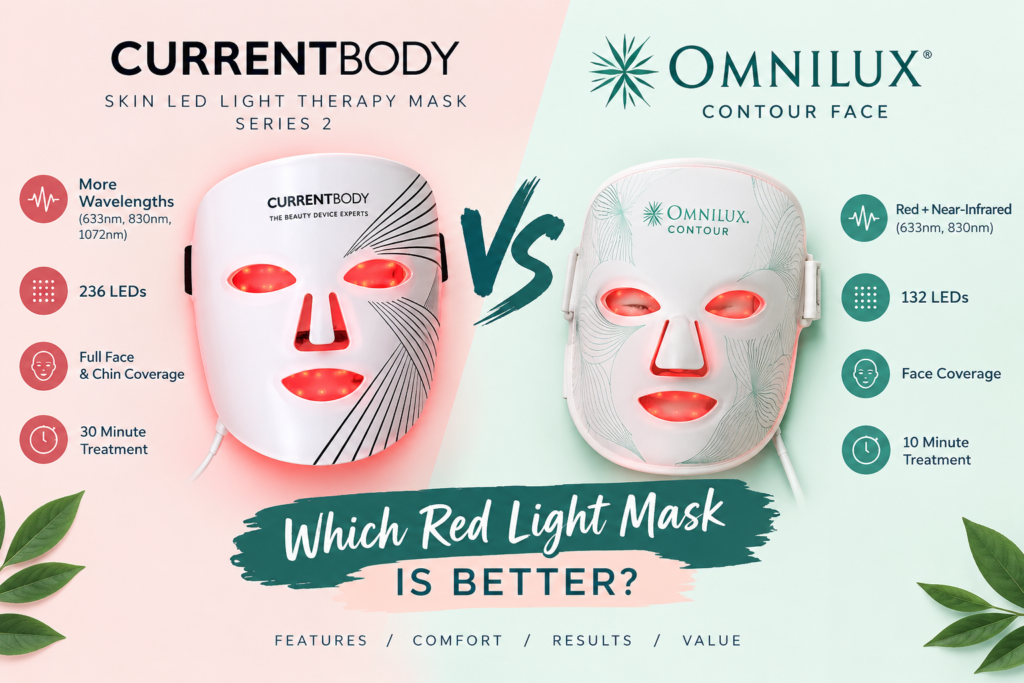
If you’ve spent any time researching at-home red light therapy, you’ve almost certainly landed on a CurrentBody vs Omnilux debate. Both brands make premium, flexible LED face masks that are frequently recommended by beauty editors and dermatology-adjacent reviewers, and both are backed by real photobiomodulation research rather than marketing fluff alone. But choosing between the CurrentBody LED Mask Series 2 and the Omnilux Contour Face isn’t as simple as picking the more popular name. They differ in wavelength count, LED configuration, coverage, fit, clinical history, and price — and the right pick really does depend on what you’re trying to fix. This guide breaks down the real specs, the real evidence, and who each mask actually suits.

- FITS TO YOU – Unlike many other wearable LED devices, the CurrentBody Light Therapy Mask is made from patented flexible …
- LIGHT THERAPY – The device combines Red (633nm) and near Infra-Red Light (830nm). Harnessed at the perfect measurement t…
- REAL RESULTS – You can expect to see visible results in just 4 weeks when used consistently 10 minutes a day, 3 to 5 tim…
Affiliate disclosure: Petal Beauty Skincare is a participant in the Amazon Associates program. We may earn a commission from qualifying purchases made through links on this page, at no extra cost to you. We were not sponsored by CurrentBody or Omnilux to write this comparison.
Quick Comparison Table
| Product | Best For | Price | Wavelengths | LED Count | Irradiance | Treatment Time | Coverage | FDA/Clearance Status | Warranty |
|---|---|---|---|---|---|---|---|---|---|
| CurrentBody Series 2 | Broader wavelength coverage, chin/jawline, deep NIR | ~$399–$469 (varies by retailer) | 633nm red, 830nm NIR, 1072nm deep NIR | 236 LEDs (reported; see note below) | ~30 mW/cm² (third-party reviewer measurement) | 10 minutes | Full face, nose, chin, lips | FDA 510(k) K250966 | 2-year warranty; 30-day unused return or 60-day money-back (10% restocking fee) |
| Omnilux Contour Face | Clinically documented anti-aging protocol, simpler routine | $395 | 633nm red, 830nm NIR | 132 medical-grade LEDs | ~28 mW/cm² (independently measured) | 10 minutes | Full face (eyes, nose, mouth openings) | FDA 510(k) K191629 | 2-year device warranty (1-year controller); return terms vary by retailer |
[Check Price on Amazon – CurrentBody Series 2] · [Check Price on Amazon – Omnilux Contour Face]
Only use the Amazon buttons above if the listing shows the product in stock and sold by the brand or an authorized seller — both masks have verified Amazon listings, but availability and price change frequently, so always confirm current details on the listing itself.
CurrentBody vs Omnilux: Quick Answer
- FITS TO YOU – Unlike many other wearable LED devices, the CurrentBody Light Therapy Mask is made from patented flexible …
- LIGHT THERAPY – The device combines Red (633nm) and near Infra-Red Light (830nm). Harnessed at the perfect measurement t…
- REAL RESULTS – You can expect to see visible results in just 4 weeks when used consistently 10 minutes a day, 3 to 5 tim…
Here’s the short version. CurrentBody Series 2 packs more LEDs and an extra wavelength (1072nm deep near-infrared) into a fuller, chin-inclusive silicone mask, which appeals to people who want maximum coverage and hardware. Omnilux Contour Face uses fewer LEDs and only two wavelengths, but those two wavelengths (633nm and 830nm) are the exact combination studied in some of the earliest and most frequently cited LED photorejuvenation research, and Omnilux’s parent company has spent over two decades building clinical relationships in dermatology.
Neither mask is objectively “better” in every scenario. If you’re most interested in a system with more hardware, deeper eye and eyebag targeting, and a wider face/chin fit, CurrentBody Series 2 leans that direction. If you’d rather buy into the wavelength combination with the longest independent research trail and a simpler two-light protocol, Omnilux Contour Face leans that direction. If you’re still comparing options broadly, our roundup of the best LED face masks for wrinkles and anti-aging in 2026 covers additional masks outside this head-to-head.
CurrentBody Series 2 Overview
The CurrentBody Skin LED Light Therapy Face Mask: Series 2 is a flexible silicone mask that wraps around the full face, including a nose flap and an extended chin section — a notable upgrade over the Series 1, which stopped short of the chin. It’s held in place with a multiway strap and includes soft eye inserts for comfort during near-infrared exposure.
Specifications reported by CurrentBody and independent reviewers:
- Wavelengths: 633nm red, 830nm near-infrared, and 1072nm deep near-infrared
- LED count: Most manufacturer-aligned sources and reviewer breakdowns cite 236 LED bulbs. Forbes Vetted’s hands-on review separately reported 263 LEDs, and one independent teardown-style review counted 110 physical diode packages (16 triple-chip units emitting all three wavelengths, plus 94 dual-chip units emitting red and 830nm only). We can’t fully reconcile these numbers, and it’s possible the differences come down to counting individual emitter chips versus physical diode packages rather than any change in the actual device — but because CurrentBody’s own current marketing consistently uses 236, that’s the figure most buyers will see.
- Irradiance: Reported at roughly 30 mW/cm² by at least one hands-on reviewer; CurrentBody does not appear to publish this figure on its own retail page, so treat it as a third-party estimate rather than a verified manufacturer spec.
- Treatment time: 10 minutes per session
- Recommended frequency: 3–5 times per week
- Coverage: Full face, nose, lips, and chin
- Comfort: Flexible silicone, multiway overhead strap, removable eye inserts
- Controller/battery: Cordless, rechargeable controller; reviewers report roughly 10 sessions per full charge
- Warranty/returns: 2-year warranty as standard; CurrentBody’s official policy allows a 30-day return on unused/unopened items, plus a 60-day money-back guarantee with a 10% restocking fee on opened devices
- Clearance: FDA 510(k) K250966, filed under “CurrentBody Skin™ LED Light Therapy Mask Series 2 (MK-90H)”
CurrentBody markets the 1072nm deep near-infrared wavelength as targeting deeper-set signs of aging, particularly around the eyes, with extra bulbs placed in that zone. That’s a manufacturer claim about why the wavelength was added, not an independent confirmation that the consumer mask produces the exact outcomes seen in the small self-reported clinical trials CurrentBody cites for 1072nm. Independent, large-scale replication of 1072nm’s specific anti-aging effects is still limited compared to the research base behind 633nm and 830nm.
If you want to see how the Series 2 stacks up against more affordable options, our guide to the best at-home LED face masks under $500 is a useful next stop.
Omnilux Contour Face Overview
- FITS TO YOU – Unlike many other wearable LED devices, the CurrentBody Light Therapy Mask is made from patented flexible …
- LIGHT THERAPY – The device combines Red (633nm) and near Infra-Red Light (830nm). Harnessed at the perfect measurement t…
- REAL RESULTS – You can expect to see visible results in just 4 weeks when used consistently 10 minutes a day, 3 to 5 tim…
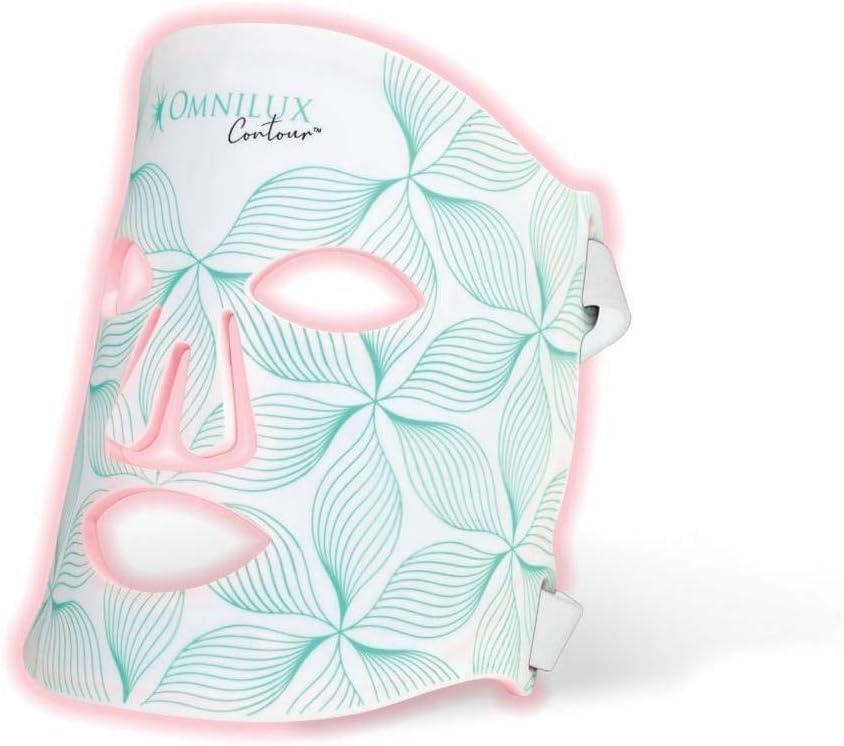
The Omnilux Contour Face is a flexible mask built by GlobalMed Technologies, the company behind Omnilux’s professional in-clinic light therapy systems. It uses 132 medical-grade LEDs delivering two wavelengths — 633nm red and 830nm near-infrared — through a soft, adjustable design with silicone eye inserts to protect against glare during sessions.
Specifications reported by Omnilux and independent reviewers:
- Wavelengths: 633nm red and 830nm near-infrared only (no deep NIR, blue, or other bands)
- LED count: 132 medical-grade LEDs
- Irradiance: One independent measurement puts real-world output at roughly 28 mW/cm², which reviewers note is close to Omnilux’s advertised output — a point in the mask’s favor, since some competing masks underperform their marketing claims
- Treatment time: 10 minutes per session
- Recommended frequency: 3–5 times per week for 4–6 weeks, then maintenance as desired
- Fit: Flexible design with an adjustable strap; the controller is external and connects by cable, which keeps weight off the face during use
- Eye comfort: Soft silicone eye inserts included
- Controller: External controller with a lithium-polymer rechargeable battery
- Warranty/returns: 2-year warranty on the device, 1-year on the controller. Return policy varies by where you buy it: orders placed directly on omniluxled.com fall under a defined return window with a flat $15 return fee, while many authorized retailers and medical spas sell Omnilux devices as final sale with no returns. Always check the specific seller’s policy before buying.
- Clearance: FDA 510(k) K191629, product code OHS, an over-the-counter clearance for wrinkle reduction
Omnilux’s marketing leans heavily on its research pedigree, and that’s largely earned — GlobalMed’s underlying LED technology has been the subject of published photobiomodulation research going back to the mid-2000s. That said, it’s worth separating the technology’s research history from the specific consumer Contour Face device: published studies used Omnilux’s professional-grade systems, not necessarily the exact irradiance, session length, or protocol of the at-home mask. The consumer device is designed to approximate that dose at a lower power output delivered closer to the skin, but it isn’t a one-to-one replication of the clinical studies.
For readers specifically weighing red light options against blue light or acne-focused devices, our comparison of LED face masks for acne and anti-aging covers that decision separately.
CurrentBody vs Omnilux: Side-by-Side Comparison
- FITS TO YOU – Unlike many other wearable LED devices, the CurrentBody Light Therapy Mask is made from patented flexible …
- LIGHT THERAPY – The device combines Red (633nm) and near Infra-Red Light (830nm). Harnessed at the perfect measurement t…
- REAL RESULTS – You can expect to see visible results in just 4 weeks when used consistently 10 minutes a day, 3 to 5 tim…
| Factor | CurrentBody Series 2 | Omnilux Contour Face |
|---|---|---|
| Price | ~$399–$469 | $395 |
| Wavelengths | 633nm, 830nm, 1072nm | 633nm, 830nm |
| LED count | 236 (reported; discrepancies exist) | 132 |
| Irradiance | ~30 mW/cm² (reviewer-reported) | ~28 mW/cm² (independently measured) |
| Treatment time | 10 minutes | 10 minutes |
| Recommended frequency | 3–5x/week | 3–5x/week, 4–6 weeks then maintenance |
| Facial coverage | Full face, nose, lips | Full face |
| Chin coverage | Yes, extended chin flap | Not a dedicated chin zone |
| Eye protection | Removable eye inserts | Silicone eye inserts |
| Fit | Flexible silicone, multiway strap | Flexible, adjustable strap, external controller |
| Comfort | Lightweight, cordless controller clips on | Lightweight; controller stays off the face via cable |
| Portability | Cordless, rechargeable | Requires external controller/cable during use |
| Warranty | 2 years | 2 years (device), 1 year (controller) |
| Returns | 30-day unused / 60-day money-back (10% fee) | Varies by retailer; some final sale |
| FDA status | 510(k) K250966 | 510(k) K191629 |
| Clinical evidence | Newer device; some CurrentBody-run and third-party lab testing | Longer independent research trail on the 633+830nm combination |
| Best use case | Broader hardware, chin/jaw coverage, deep NIR interest | Evidence-focused buyers wanting a simpler, well-studied protocol |
Wavelengths Explained
633nm (red light) sits at the visible red end of the spectrum and is the most widely studied wavelength in consumer LED devices. It’s generally associated with surface-level skin appearance — tone, texture, and the visible softening of fine lines.
830nm (near-infrared) is invisible to the eye and penetrates further into the skin than red light. It’s the wavelength most associated in the research with supporting collagen-producing fibroblast activity and calming inflammation.
1072nm (deep near-infrared), found only in the CurrentBody mask here, penetrates deeper still. CurrentBody frames it as reaching structures below where 830nm typically acts, but the independent research base specific to 1072nm for facial anti-aging is smaller and newer than the research behind 633nm and 830nm.
It’s worth being careful with the assumption that “deeper is always better.” Wavelength selection matters more than simply counting LEDs or maximizing penetration depth — different depths interact with different types of tissue, and more penetration doesn’t automatically translate into more visible improvement for every skin concern. A mask with fewer, well-targeted wavelengths delivered at an appropriate, consistent dose can perform comparably to a mask with more hardware. This is also why LED count alone is a misleading way to compare masks — a device’s actual output depends on chip quality, spacing, and drive current, not just the raw number of bulbs.
Which Is Better for Wrinkles and Fine Lines?
- FITS TO YOU – Unlike many other wearable LED devices, the CurrentBody Light Therapy Mask is made from patented flexible …
- LIGHT THERAPY – The device combines Red (633nm) and near Infra-Red Light (830nm). Harnessed at the perfect measurement t…
- REAL RESULTS – You can expect to see visible results in just 4 weeks when used consistently 10 minutes a day, 3 to 5 tim…
Both masks target fine lines and wrinkles using red and near-infrared light, and both have real research behind that mechanism generally. Omnilux’s 633nm+830nm combination is the more extensively documented pairing for wrinkle reduction and skin firmness in independent literature. CurrentBody’s Series 2 uses the same two wavelengths plus 1072nm, which the brand says extends benefits to areas like crow’s feet and under-eye lines, though this claim rests more heavily on CurrentBody’s own testing than on independently replicated studies.
Neither device should be expected to “erase” wrinkles. The realistic, evidence-supported outcome for consistent LED use over weeks to months is a gradual, modest improvement in the visible depth of fine lines, skin texture, and firmness — not a dramatic, permanent transformation. If wrinkle reduction specifically is your top priority, our dedicated list of LED face masks for wrinkles and anti-aging can help you compare more devices side by side.
Which Is Better for Mature Skin?
For someone primarily concerned with visible signs of aging — loss of firmness, deeper static lines, uneven texture — the deciding factor usually comes down to coverage and wavelength preference rather than age itself. CurrentBody’s chin coverage and extra 1072nm bulbs around the eyes may appeal to anyone specifically bothered by jawline laxity or crow’s feet. Omnilux’s simpler two-wavelength approach and longer research trail may appeal to anyone who wants to stick with the most established protocol rather than a newer, broader one. We’d point readers to our LED masks for mature skin and fine lines guide for more device options built specifically around this concern.
Which Is More Comfortable?
- FITS TO YOU – Unlike many other wearable LED devices, the CurrentBody Light Therapy Mask is made from patented flexible …
- LIGHT THERAPY – The device combines Red (633nm) and near Infra-Red Light (830nm). Harnessed at the perfect measurement t…
- REAL RESULTS – You can expect to see visible results in just 4 weeks when used consistently 10 minutes a day, 3 to 5 tim…
Based on hands-on reviewer accounts (not our own first-hand testing), both masks use flexible, skin-contouring materials rather than rigid shells. CurrentBody’s chin and nose flap enclose more of the lower face, while Omnilux leaves that area more open. CurrentBody uses a multiway overhead strap and a cordless, clip-on controller, so you can move freely during a session; Omnilux’s controller connects by an external cable, which keeps weight off the mask itself but tethers you closer to the unit while it’s running. Both include soft silicone eye inserts. These notes come from published reviews and manufacturer descriptions, not from Petal Beauty Skincare’s own testing.
Which Has Better Clinical Evidence?
This is the section to read carefully, because “clinically proven” gets used loosely in this category.
A. Evidence for LED/red-light therapy generally: There is a substantial, decades-long research base showing that red and near-infrared LED light (photobiomodulation) can support collagen-related activity and modestly improve the visible appearance of fine lines and skin texture in some study populations, per FDA guidance on photobiomodulation devices and independent reviews of the evidence.
B. Published research involving 633nm + 830nm specifically: Multiple peer-reviewed studies, including trials published in dermatology journals, have tested this exact combination and reported statistically significant improvements in wrinkle depth, skin softness, and collagen density after multi-week treatment courses. One randomized, placebo-controlled, split-face study compared 830nm alone, 633nm alone, a combination of both, and a sham light across weekly sessions over four weeks, finding measurable wrinkle reduction (up to 36%) and increased skin elasticity (up to 19%) in the active treatment groups compared to sham.
C. CurrentBody’s independent product testing: CurrentBody references its own dermatological studies (some run internally, some through third-party labs) on the Series 2 mask specifically, plus its Veritace testing system for LED consistency. Veritace is a CurrentBody-run quality process, not an independent third-party certification.
D. Omnilux’s product/technology evidence: Omnilux’s underlying 633nm/830nm technology traces back to the same core research used across the professional Omnilux Medical product line, and the company frequently cites its FDA clearance and decades of dermatology use as differentiators. Independent testers have also found its real-world power output close to what’s advertised, which isn’t true of every device in this category.
E. Marketing claims: Both brands describe their masks as “clinically proven.” In both cases, this generally refers to the underlying wavelengths and general mechanism of action being studied, plus brand-specific testing on the device itself — not a guarantee that every individual buyer will see the same magnitude of results reported in a small study sample.
CurrentBody Series 2 vs Series 3
- FITS TO YOU – Unlike many other wearable LED devices, the CurrentBody Light Therapy Mask is made from patented flexible …
- LIGHT THERAPY – The device combines Red (633nm) and near Infra-Red Light (830nm). Harnessed at the perfect measurement t…
- REAL RESULTS – You can expect to see visible results in just 4 weeks when used consistently 10 minutes a day, 3 to 5 tim…
If you go looking for the Series 2 on CurrentBody’s own website today, you may only find the newer LED Light Therapy Mask: Series 3 listed for direct sale — CurrentBody has shifted its primary marketing to Series 3, so Series 2 units are now mainly found through retailers, resellers, and marketplace listings rather than CurrentBody’s front-page storefront. That’s why it’s easy to get confused about which mask you’re actually comparing.
- Series 2 uses three wavelengths: red (633nm), near-infrared (830nm), and deep near-infrared (1072nm), in the 236-LED flexible silicone mask described above.
- Series 3 keeps the same general mask shape and silicone design but adds three more wavelengths — blue (415nm), green (532nm), and yellow (590nm) — for a total of six, delivered across roughly 750 LED bulbs. It also introduces a “MyDose” system that lets you assign a specific wavelength to individual LEDs and adjust treatment via a connected app, plus an interactive display on the controller.
Series 2 and Series 3 are not the same product — Series 3 is a broader, multi-wavelength system with personalization features that Series 2 doesn’t have, and it’s typically sold at a higher price point. If you see “CurrentBody LED mask” listed today, double-check whether it’s labeled Series 2 or Series 3 before comparing pricing or specs, since the two are easy to mix up in search results and on marketplace listings.
Pros and Cons
CurrentBody Series 2
Pros:
- Three wavelengths, including 1072nm deep near-infrared not found in most competing masks
- Extended chin and nose coverage for a fuller-face treatment
- Cordless, rechargeable controller for full mobility during sessions
- 2-year warranty plus a 60-day money-back window (with restocking fee)
Cons:
- LED count is reported inconsistently across sources, making hardware claims harder to verify with full confidence
- Newer device with a shorter independent research trail specific to the 1072nm wavelength
- Now overshadowed on CurrentBody’s own site by the pricier Series 3, which can create confusion when shopping
- Higher typical price than Omnilux Contour Face
Omnilux Contour Face
Pros:
- Uses the most extensively independently studied red + near-infrared combination in this category
- Independently measured output that closely matches its advertised irradiance
- Backed by a company with decades of professional dermatology-grade LED manufacturing history
- Simple two-wavelength protocol with a clearly defined 4–6 week regimen
Cons:
- No chin-specific coverage zone
- Only two wavelengths, so it won’t appeal to buyers who want a broader multi-light system
- Return policy is inconsistent across sellers, and some retailers treat it as final sale
- External, tethered controller may feel less convenient than a fully cordless design
Who Should Buy CurrentBody?
- FITS TO YOU – Unlike many other wearable LED devices, the CurrentBody Light Therapy Mask is made from patented flexible …
- LIGHT THERAPY – The device combines Red (633nm) and near Infra-Red Light (830nm). Harnessed at the perfect measurement t…
- REAL RESULTS – You can expect to see visible results in just 4 weeks when used consistently 10 minutes a day, 3 to 5 tim…
CurrentBody Series 2 tends to make more sense if you:
- Want broader wavelength coverage, including the deep near-infrared band
- Care specifically about chin, jawline, and lower-face coverage in addition to the upper face
- Prefer a fully cordless, clip-on controller for mobility during treatment
- Are comparing against other high-LED-count masks and want to stay in that category
Who Should Buy Omnilux?
- FITS TO YOU – Unlike many other wearable LED devices, the CurrentBody Light Therapy Mask is made from patented flexible …
- LIGHT THERAPY – The device combines Red (633nm) and near Infra-Red Light (830nm). Harnessed at the perfect measurement t…
- REAL RESULTS – You can expect to see visible results in just 4 weeks when used consistently 10 minutes a day, 3 to 5 tim…
Omnilux Contour Face tends to make more sense if you:
- Prioritize a device whose exact wavelength combination has the longest independent research trail
- Value the reputation of a company built primarily around professional-grade light therapy technology
- Prefer a simpler two-wavelength routine over a broader multi-light system
- Want a device with independently verified output close to its advertised specs
Value for Money
At roughly similar price points (CurrentBody Series 2 typically $399–$469; Omnilux Contour Face at $395), this isn’t a “cheaper vs. pricier” decision — it’s about what you get for a comparable spend. CurrentBody’s extra hardware, wavelength, and chin coverage add real functional differences, though they come with specs that are harder to verify consistently across sources. Omnilux charges a similar amount for a narrower, more established feature set with a longer clinical track record. Neither is objectively the better value; it depends on whether you’d rather pay for more hardware and coverage, or for a narrower, well-documented protocol.
Final Verdict
There’s no universal winner here — the better mask depends on what you’re optimizing for.
- If your priority is broader coverage (including your chin and jawline) and you want the extra 1072nm wavelength, CurrentBody Series 2 may make more sense for you.
- If your priority is buying into the most independently researched red + near-infrared combination with a simpler, well-defined routine, Omnilux Contour Face may make more sense for you.
- If you’re mainly deciding between CurrentBody Series 2 and the newer Series 3 rather than Omnilux, remember that Series 3 adds three more wavelengths and app-based personalization at a higher price — worth factoring in before you compare pricing across retailers.
Whichever you choose, plan on a multi-week commitment (most manufacturer guidance points to 4–8+ weeks of consistent 3–5x weekly use) before expecting to see a visible difference, and always check current listings for the seller’s exact model, price, and return terms before buying.
FAQ
Is CurrentBody better than Omnilux? Neither is universally “better.” CurrentBody Series 2 offers more LEDs, an extra wavelength (1072nm), and chin coverage, while Omnilux Contour Face offers a narrower but more extensively independently studied two-wavelength combination. The right choice depends on whether you value broader hardware or a simpler, well-documented protocol.
Is Omnilux Contour worth the money? For buyers who prioritize independently verified output and a wavelength combination with a long research history, many reviewers consider it worth the roughly $395 price. It’s a narrower feature set than CurrentBody Series 2, so it suits people who want a straightforward routine rather than a multi-wavelength system.
Does CurrentBody have more LEDs than Omnilux? Yes — CurrentBody Series 2 is most commonly reported at 236 LED bulbs versus Omnilux Contour Face’s 132. However, LED counts for the CurrentBody mask vary somewhat across sources, so treat the exact figure as approximate rather than a fixed number.
What is the difference between 830nm and 1072nm? Both are near-infrared wavelengths invisible to the eye. 830nm is the more widely studied of the two for skin firmness and collagen-related activity, while 1072nm penetrates deeper and is marketed by CurrentBody as targeting more pronounced signs of aging, though independent research on 1072nm specifically is more limited.
How often should you use these LED masks? Both CurrentBody Series 2 and Omnilux Contour Face recommend 10-minute sessions, 3 to 5 times per week. Omnilux specifies an initial 4–6 week course followed by maintenance use, while CurrentBody’s guidance similarly points to a multi-week consistency window before expecting visible change.
Can LED masks really reduce wrinkles? Peer-reviewed studies on red and near-infrared LED light, including the 633nm+830nm combination used in both masks, have shown measurable (though generally modest) improvements in wrinkle depth and skin elasticity after weeks of consistent treatment. Results vary by individual, and neither device should be expected to eliminate wrinkles entirely.
Which is better for mature skin? It depends on your specific concern. CurrentBody’s chin coverage and deep near-infrared wavelength may appeal to those focused on jawline laxity or under-eye lines, while Omnilux’s established two-wavelength protocol may appeal to those who prefer sticking with the most independently documented approach.
Is CurrentBody Series 2 still worth buying now that Series 3 exists? Yes, for buyers who don’t need the additional blue/green/yellow wavelengths or app-based personalization that Series 3 adds. Series 2 remains a legitimate three-wavelength device in its own right — just confirm you’re buying the Series 2 model specifically, since retailers sometimes list both side by side.
Looking for more options beyond these two? Check out our full breakdowns of the best red light therapy masks on Amazon in 2026 and the best LED face masks under $500 for additional side-by-side comparisons.
Sources
- CurrentBody – LED Red Light Therapy Face Mask (official product and clinical study page)
- CurrentBody – Series 2 vs Series 3 vs Multi-Light mask comparison (official)
- Omnilux – Contour Face official product page
- PubMed – A study to determine the efficacy of combination LED light therapy (633nm and 830nm) in facial skin rejuvenation
- FDA – Photobiomodulation (PBM) Devices premarket guidance